Two of Northern Ireland’s most decorated sporting figures have revealed how cardiovascular disease abruptly forced them into retirement.
Former Ulster and Ireland rugby prop Simon Best, from Co Armagh, and Derry GAA All Star Kevin McCloy have shared their experiences of living with serious heart conditions to raise awareness of cardiovascular disease and highlight the importance of research.
For Simon, his career came to a sudden halt at the 2007 Rugby World Cup in France.
The then 30-year-old was at peak fitness and preparing to help Ireland progress through the tournament when he suddenly became unwell between pool matches, experiencing a headache, difficulty speaking and loss of sensation down his right side.
The episode was later diagnosed as a TIA (transient ischaemic attack), often described as a mini-stroke, and further investigations revealed he had an irregular heart rhythm.
Not only was his World Cup over, but doctors advised him to retire from professional rugby due to the intensity of the sport.
Simon said: “My first experience was completely out of the blue. I had a medical event at the Rugby World Cup in 2007, it was mid-week between pool games, I was at peak fitness, it was the biggest competition of my career.
“I had a TIA (Transient Ischaemic Attack or ‘mini-stroke’) and was diagnosed with an irregular heartbeat. I was very fortunate I was in Bordeaux surrounded by the Ireland Rugby medical team and cardiologists in the local hospitals.
“But unfortunately it was the end of my rugby career.”
Simon spent six days in a French hospital and underwent extensive testing.
He was presented with three options – lifelong medication, ablation surgery or routine monitoring without medication.
He chose the latter and has thankfully experienced no further symptoms.
He said: “The most important thing in my case was that I received treatment and prevention early on as soon as I experienced symptoms. I now have checks every three to five years.
“It was far from an easy decision to make to retire from international rugby because of the diagnosis, as I was at such a high level of competition.”
The Co Armagh man admitted stepping away from the sport he loved was difficult, particularly as he had recently married and believed he still had several years left at the top level with Ulster and Ireland.
He added: “When you go through a serious health issue, getting perspective is important and this led me to realise that when one chapter closes, another one opens.”
Simon said his experience underlined that cardiovascular disease can affect anyone, regardless of age or physical condition.
“I was young and at my peak physical fitness and possibly the pinnacle of my sporting career when I got my diagnosis of an irregular heartbeat.
“I want to raise awareness that there is no ‘one size fits all’ for cardiovascular disease – it can affect any person at any time in their life and its impact is often life-changing.”
For Derry GAA legend Kevin McCloy, his ordeal began dramatically on the pitch in 2014.
The former Lavey and Derry defender collapsed just 10 minutes into a county championship match against Magherafelt at Owenbeg.
Without warning, the then 35-year-old suffered a cardiac arrest.
His life was saved by the quick-thinking actions of doctors who were attending the game as spectators, alongside ambulance staff and a nearby defibrillator.
Kevin’s heart had stopped for seven minutes.
He was placed in a medically induced coma and transferred to hospital, where he suffered another cardiac arrest during surgery. Doctors implanted an ICD (implantable cardioverter defibrillator) in his chest to control life-threatening heart rhythms.
Kevin said: “It was 2014, I was 35 and playing in a Championship match, a very important game.
“Ten minutes in without any prior symptoms, I collapsed on the pitch. The next thing I remember is when I woke from an induced coma in Altnagelvin Hospital several days later.
“I’m told that my heart stopped for seven minutes in total, before the defibrillator restarted it and helped to save my life.”
The incident marked the end of his playing career and the beginning of a long, uncertain battle with his health.
He said: “I left hospital three or four days afterwards and my life changed forever.”
Once home, Kevin was told he could no longer take part in intensive physical activity.
The adjustment from elite athlete to someone managing a life-threatening condition was immense.
“After playing an intense sport, I was extremely passionate about at the highest level, I was told not to exercise.
“I couldn’t yet return to work, and I didn’t even know if it was safe for me to take kids out by myself. My life was turned on its head.”
Although he gradually rebuilt his confidence, his health deteriorated again within a year.
Tests revealed his heart function had dropped significantly and discussions began around the possibility of a heart transplant.
Further investigations eventually led to a diagnosis in 2018 of cardiac sarcoidosis, a rare inflammatory disease affecting the heart muscle.
Kevin said: “I was only 37-years-old at the time with four young kids under the age of six and couldn’t accept that this was the only option.
“This took a significant amount of time to do all the tests required and in 2018, I was diagnosed with cardiac sarcoidosis which is an inflammatory disease.”
The diagnosis explained the severe scarring in his heart and the dangerous rhythm disturbances he had experienced.
Treatment involved intensive steroid therapy and immunosuppressants, but even then Kevin suffered three more cardiac arrests while in hospital.
He said: “It was a terrifying experience for me and my family as I didn’t know what the future held.”
Twelve years on from his first cardiac arrest, Kevin continues to manage his condition through medication and regular monitoring.
Although he can no longer play, he has channelled his competitive instincts into coaching.
He said: “There was a massive void from giving up what was a way of life for me since I was a child and I found it hard to fill that void.
“With any sports person playing at the highest level, you need adrenaline and that’s what led me to coaching. While it is not by any means a replacement for playing, it still offers me a competitive outlet.”
The impact on family life remains profound.
Kevin, now a father of four, says cardiovascular disease has changed what he can do with his children and continues to affect daily life.
“People look at me and think I’m a picture of health but they don’t see the impact of cardiovascular disease.
“I enjoy family life but I’m not fit to do all the things I would like to do with the kids. Every time my ICD goes off it takes me a long time to get over it.”
He remains deeply grateful to those who saved his life that day in Owenbeg.
“I’m so thankful for all of the support I’ve received. From the spectators at the match who saved my life after my cardiac arrest to The Cormac Trust who had provided the club defibrillator that was used to restart my heart.”
Kevin also strongly supports the British Heart Foundation’s research into cardiovascular disease.
“With more funding for research into cardiovascular disease and increased awareness of its impact, I’m hopeful for the future that better treatments and quite possibly cures can be found.”
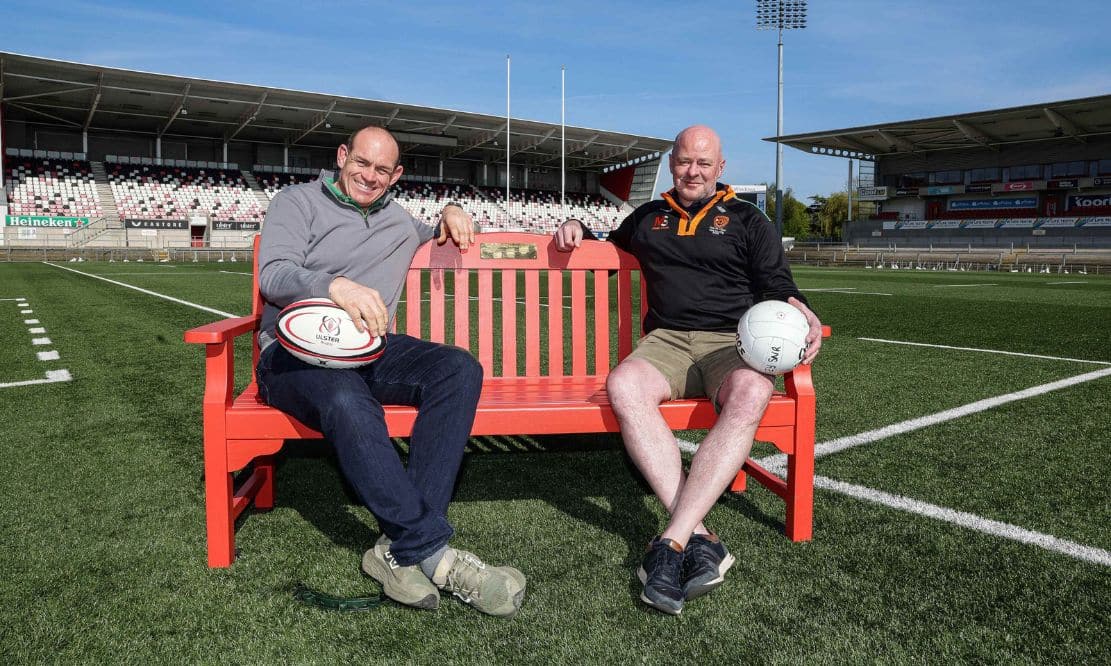
Simon and Kevin are sharing their stories as part of British Heart Foundation’s ‘Keep Us Beating’ campaign, which marks 65 years of the charity’s lifesaving work.
To commemorate the milestone, 65 red benches have been unveiled across the UK in tribute to those living with cardiovascular disease.
Each bench represents a real-life story of survival and resilience.
In Northern Ireland, the campaign aims to spark conversations around cardiovascular disease and challenge misconceptions surrounding a condition that affects more than 230,000 people locally.
Every day, around 12 people in Northern Ireland die from cardiovascular disease.
Fearghal McKinney, Head of British Heart Foundation Northern Ireland, said: “Kevin and Simon’s stories show the true reality of the devastating impact cardiovascular disease can have, both on their careers and home life and we are so grateful that they have courageously shared their experience to help others.
“Despite being one of Northern Ireland’s biggest killers, we have found that cardiovascular disease is still misunderstood or not taken seriously.
“By sharing the stories of people who live with cardiovascular disease on our iconic red benches in Northern Ireland, we hope to start more conversations that change dangerous misconceptions.”
The charity is urging people across Northern Ireland to support its work by donating to help fund pioneering research into improved treatments and cures.
Every day, around 12 people in Northern Ireland die from cardiovascular disease.
To support the campaign and help keep Northern Ireland’s hearts beating, visit bhf.org.uk/what-we-do/in-your-area/northern-ireland/keep-northern-ireland-beating.