Fresh calls have been made for a memorial or marker to indicate the actual site of the 1889 Armagh Rail Disaster, in which 88 lives were cruelly lost.
A proud Armachian, leading academic Professor Paddy Gray believes the ongoing failure to appropriately recognise the site is an insult to the men, women and children who died.
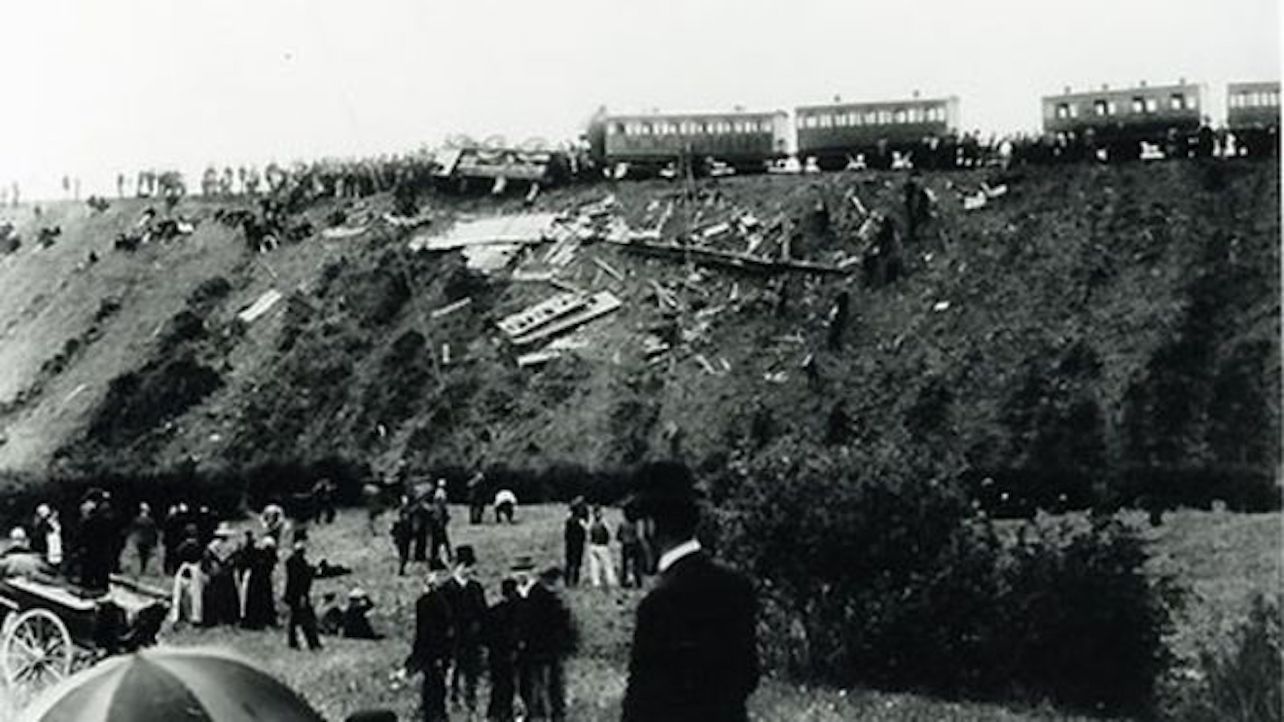
It was on the morning of June 12, 1889, that the tragedy occurred, in an area just off the Portadown Road, on the outskirts of the city.
There was an air of air excitement that morning, as children on a Sunday School excursion, from Armagh Methodist Church, had been looking forward to a day out at the seaside in Warrenpoint.
The crowded excursion train had tried to negotiate a steep incline, stalling the train. The crew divided the train and took forward the front portion, leaving the rear on the running line.
But the rear portion was inadequately braked and ran back down the gradient, colliding with a following train and resulting in carnage of horrifying proportions.
In all, 88 people from all walks of life were killed while 260 others were injured.
It became Armagh’s darkest day, the city’s Titanic, such was the incomprehensible scale of the disaster and the number of lives so tragically lost.
A memorial plaque has been erected in remembrance of those who died within Armagh Methodist Church.
And on the Mall in Armagh stands the sculpture of a little girl, in a sundress, clutching a bucket and spade, indicative of the many of her age whose childlike enthusiasm for a day by the sea was snuffed out before it even began.
That beautifully poignant piece – atop a plinth bearing the names of all who perished – was erected in 2014, unveiled then to mark the 125th anniversary of the Armagh Railway Disaster.
Yet the site of the tragedy itself remains unmarked in any tangible way.
Professor Gray thinks it is now long overdue that something needs be done to reverse that injustice.
He has previously raised the issue with ABC Council at officer level, finding them “sympathetic” to his suggestion.
And he has also flagged the need for an official marker via social media posts.
Now he believes that whatever needs done must be done to finally make it happen.
Professor Gray told Armagh I : “I would doubt whether the council would fund something like that unless there was pressure put on them. Even if it was to seriously consider the matter and at least provide part funding would be a step forward.
“We need something that would basically signify the site where the disaster happened, because so many people who don’t come from Armagh dont know anything about the disaster. That’s what I was amazed at.
“When you come out of Armagh, you start to hit a dual carriageway on the left hand side. Just before that, if you look over to the right, you can see where the railway was.
“I always remember when I was young being brought out there from school to look at it.
“But there’s isn’t even a sign or anything just to say this was where the Armagh Rail Disaster happened.”
Professor Gray believes the sculpture on the Mall is a very fitting memorial to what happened and it should remain where it is. But he also points out that anyone passing along by car simply would not see it.
Similarly, anyone driving along the Portadown Road would have no idea of what unfolded there 137 years ago.
“At the end of the day, something there would trigger people’s minds that a disaster happened when they’re driving past and it might get them to look into it a bit more,” explained Professor Gray. “That was my personal thinking.
“It’s something I feel strongly about and my biggest concern is that so many people in Northern Ireland don’t know about it. They don’t know the history, that this massive disaster with so many children killed happened right on their doorstep. It’s a bit about educating people, alerting people that maybe they would then start to look into it.
“The railway itself closed long ago and there is no large preserved crash site. However, parts of the old railway embankment and track-bed remain visible in the landscape.
“If you know where to look while driving out of Armagh towards Portadown, you can see sections of the former line and embankment, and the scene of the disaster, but there is nothing there to explain the significance.
“For most motorists, it would not be obvious that they are passing the site of Ireland’s worst railway disaster and the most prominent public memorial is not at the site of the disaster but, rather, on the Mall.
“I think it’s so important that people should understand that a disaster of that scale happened there. There are so many tourists and people driving past. Every time I come up to Armagh, that road is always very busy.
“I know that you don’t like marking deaths and things, but look at Titanic. Look at the sort of things that tourists are being brought into Belfast for, such as the Troubles, and looking at where things happened. At the end of the day, it’s something that should have been done years ago and I am so surprised that so many people have never heard of it.”
In terms of how the scene of the tragedy – to this day still the fourth worst rail disaster in the UK – could be marked, Professor Gray has a very real vision of what should now happen.
And in terms too of timeframe – and with a real and united drive to make it happen – he has the perfect milestone in mind.
“I was thinking of something like the Angel of the North in Gateshead, England,” added Professor Gray. “It cost £800,000 in 1998, so obviously costs would be much higher now.
“But a monument like it would have real significance. A lot of it was funded by National Lottery.
“I would be happy to get involved in fundraising, particularly with business people and contacts I have, but I’m sure funding could be sourced from cross-border funds, churches and many other organisations and individuals.
“I think with a major effort on my behalf and others, we could raise the funds for something striking.
“It would be so symbolic and it would be great to have it erected for the 140th anniversary in 2029, which gives us three years to pull it together.”