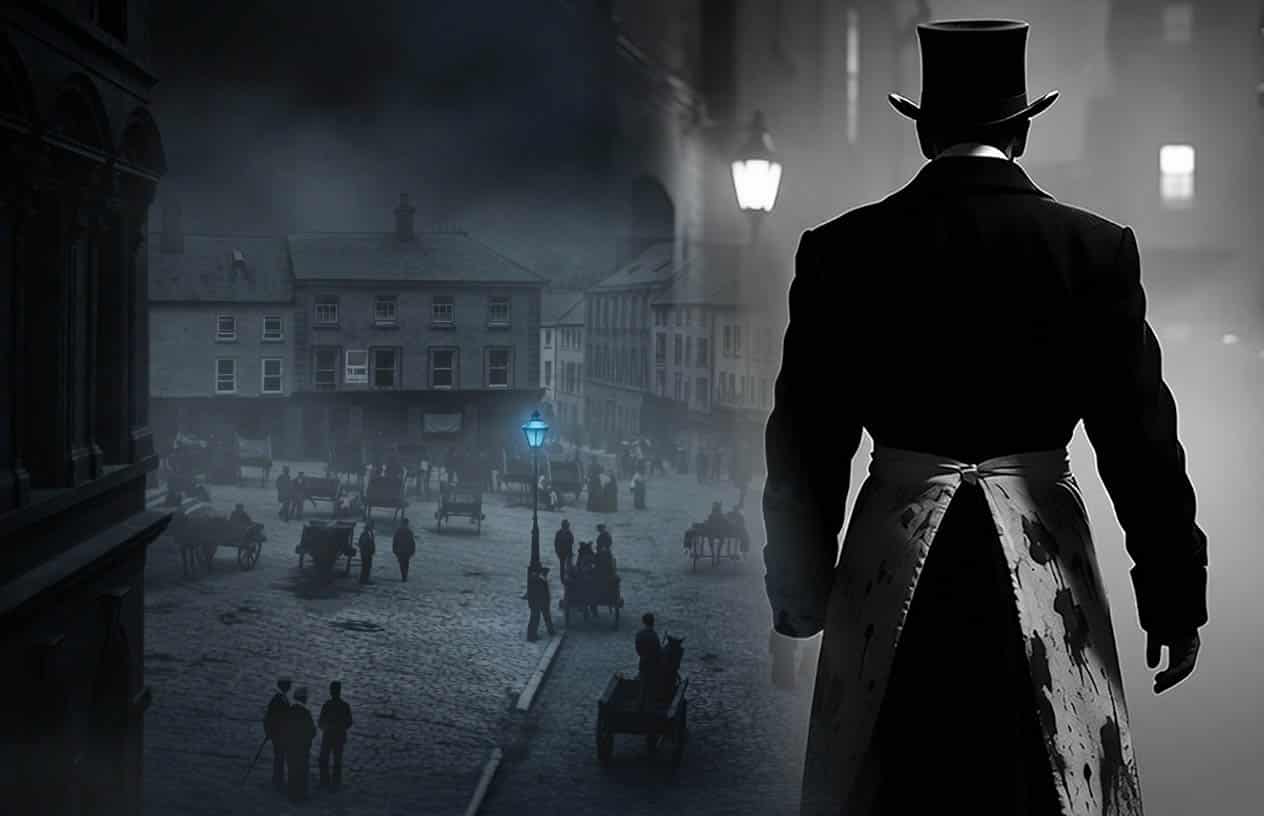
He was never caught and to this day the exact number of his victims is not known.
Jack the Ripper led a reign of terror over the streets around Whitechapel, in London’s East End, back in 1888.
From Hollywood movies to made-for-TV dramas, what is known of the attacks which he carried out has been committed to film many, many times over the years. Endless books have been written, countless conspiracy theories bandied about.
And for one fleeting moment, back in October 1888, attention turned to Armagh after the arrest of a tramp – in possession of a bloody knife – in Market Street!
Taken to the police station at Russell Street, also found in his possession on that day was a letter addressed to the Roman Catholic Primate – also stained in blood – which had been signed ‘Leather Apron’.
Official tours conducted around Whitechapel today will readily explain that ‘Leather Apron’ was a name given by prostitutes to police during the course of their enquiries into the aptly-monikered monster Jack the Ripper.
According to the original Jack the Ripper Tour – which was established in 1982, almost a century on from the Ripper’s horrific crimes – The Star newspaper ran the first of several articles, on September 5, 1888, in which the name was used.
It described ‘Leather Apron’ as the “only name linked with the Whitechapel murders”, the “strange character who prowls about after midnight” causing “universal fear among women”.
There was, therefore, some police attention when the name appeared on the letter seized on a man arrested in Armagh.
There are five confirmed victims of Jack the Ripper – Mary Ann Nichols, Annie Chapman, Elizabeth Stride, Catherine Eddowes, and Mary Jane Kelly – given the similarities in their brutal deaths.
But up to six others are still considered as possible victims, including Frances Coles, who was butchered in 1891 and whose mother, Mary Ann Carney, came originally from Armagh.
Everyone was a suspect, with particular attention on butchers, slaughterhouse operators, and physicians and surgeons, due to the way in which the internal organs were removed from some, indicating the killer had anatomical knowledge and precision.
The first of the known five victims of the Ripper – who taunted police by letter – was found on August 31, 1888, and the last on Friday, November 9, that same year.
When the Armagh arrest was made, it provided the perfect ‘read-all-about-it’ newspaper fayre for everyone from the now-defunct Dublin Daily Express to the Northern Whig, the South Wales Echo to the city’s own Armagh Standard.
The former ran with the headline: ‘Leather Apron’ in Armagh’.
The correspondent of the day, in the newspaper of October 12, 1888, wrote: “At the Armagh Petty Sessions yesterday, before Captain Preston, Pell and Mr George A. Edwards, JP, a tramp named William Robinson, who gave his name as Leather Apron, and in whose possession a bloodstained knife and a begging letter, addressed to the Roman Catholic Primate, which was similarly blood-stained, were found, was brought up, charged with drunkenness and disorderly conduct at Armagh on last Thursday night, and with having violently assaulted a constable in the police station.
“Evidence was given of his arrest, and of his having struck the constable in the police station, and torn up his clothes during the night, but Head Constable Magee assured their Worships that he could not be really Leather Apron, because he had been convicted at Warrenpoint on the 21st of August for assaulting the police, and sentenced to six weeks imprisonment, from which he had only been liberated on the day of his arrest.”
The perfect alibi did not lessen the publications’ push to print and be damned!
The Armagh Standard provided more on the arrest and appearance before Petty Sessions of Robinson, who had been taken into custody and appeared on remand charged with “drunkenness” by Sgt Donnellan.
It reported: “The sergeant was examined in the case and deposed to the arrest of the prisoner, and having had a knife produced in his pocket with blood on it, on a letter addressed to the Roman Catholic Primate, also with blood on it.
“He gave his name as William Robinson.
“The prisoner was also charged with having, in the barrack, after his arrest, assaulted Constable M’Morris. The information of Constable M’Morris stated that he arrested the defendant in Market Street for drunkenness.
“When they brought him to the barrack, they searched him, and witness was about taking taking him down to the strong room, when he turned round and deliberately struck him a blow with his clenched fist on the forehead. He also tore off his cape as he was taking him downstairs.
“When in the day room, he gave his name as Leather Apron. He tore all his clothes to pieces when in the lock up.
“Head Constable Magee stated that the prisoner had been remanded under the name of Leather Apron, but from inquiries he had made, he thought it right to say that he could not possibly be Leather Apron. His name was William Robinson, and he had been convicted at Warrenpoint Petty Sessions, on the 21st of August, for assaulting the police there, and he had got six weeks imprisonment. He had only been liberated on the day of his arrest, and could not, therefore, have had anything to do with the atrocities in London.
“With regard to the blood, he thought it right to mention that when he got drunk, not knowing the knife was there, he caught his hand by thrusting it in his pocket.”
Robinson was sentenced by the Magistrates to two months in prison with hard labour.
The prisoner – who had “complained of his sufferings in the barrack” – enquired what would become of the knife, stating: “ It is my property.”
And having been duly informed by police he would “not get it for the present”, Robinson responded: “That is a terrible way to treat a man in this part of Ireland.”
Armagh’s headline-grabbing arrest was a brief footnote – an attention-seeking red herring, as it were – in a bloody and murderous chapter in these islands’ history, one which to this day manages to feed the imagination of the conspiracy theorists and intrigue, disgust – even entertain – the macabre-hungry masses.
Source material: www.casebook.org