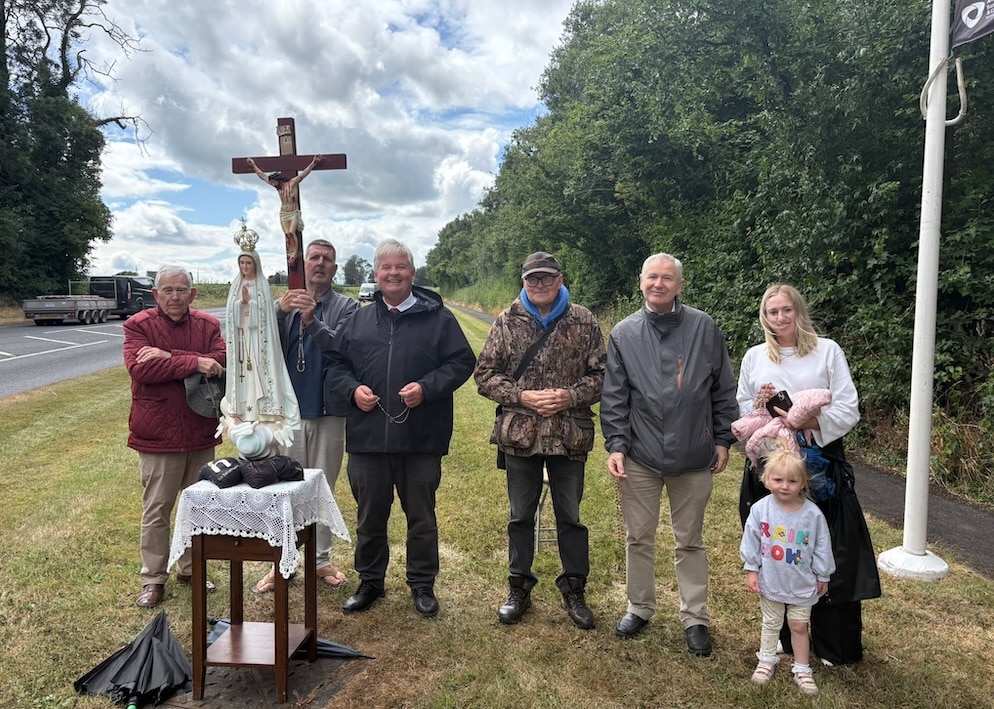
A well-known activist has branded this weekend’s Wickerman Gathering at Navan Fort in Armagh a “satanic pagan festival” and led a roadside rosary protest on the eve of the event stating that “Our Lady is here to crush the head of the serpent”.
Gerry McGeough was among up to a dozen people who gathered outside the Navan Centre & Fort on Friday afternoon, praying what he described as a “rosary of reparation” ahead of the annual Lughnasa celebration.
The Wickerman Gathering is billed as an evening celebration of the ancient Celtic festival of Lughnasa, featuring the dramatic burning of a 30‑foot willow and hazel effigy. This year’s event is scheduled for Saturday, August 1, 2026, from 6.30pm to 10.30pm.
Speaking to Armagh I at the roadside, Mr McGeough said those present believed the festival was spiritually dangerous and at odds with Ireland’s Christian heritage.
“We have gathered here today on the eve of what we consider to be an abomination,” he said.
“We’re here praying a rosary of reparation for what is to take place here tomorrow, namely a satanic pagan festival in honour of the so‑called god Lugh, who is actually like a demon.
“Christianity suppressed all of that, and Saint Patrick himself is on record quite literally as saying that we should be worshipping our Lord, the Trinity, the Triune God, as opposed to these demonic pagan gods.”
Pointing to the long pre‑Christian history of Emain Macha/Navan Fort, he claimed it had once been “a huge centre of paganism” and that he and others believed human sacrifices had taken place there.
“Emain Macha, of course, was a very important centre throughout several millennia, but a lot of people don’t realise it was also a huge centre of paganism, and we are of the belief that a lot of human sacrifices took place here,” he said.
Mr McGeough linked the site’s later Christianisation to the arrival of Saint Patrick and the Clan Colla, and argued that the decline of pagan practices at Emain Macha had been seen historically as a spiritual victory.
“We also are of opinion that it had to be crushed, let us say, Emain Macha, in order for the demonic forces that were very strong here to be suppressed, and for Christianity to get a toehold, and of course to spread right across the island of Ireland and indeed beyond,” he said.
“It’s also worth keeping in mind that as late as the 700s AD, poets in Kerry were praising the fact that Catholicism and Christianity had taken full root and was thriving and flourishing in Ireland, and that weeds and thorns were growing on Emain Macha or Navan Fort, as it is called today. So even as late as the 700s, people were aware that this was a centre of tremendous evil.”
He said he believed a weakening of religious practice in modern Ireland meant many people now viewed such events as harmless entertainment.
“The faith generally in Ireland has become very weak, and so people kind of go with the flow. They think, ‘Oh, it’s just a festival,’” he continued.
“But the wicker man, of course, is a very ancient pagan symbol in which human sacrifice took place, and people were actually burned alive. So we’re here as an act of reparation.”
Mr McGeough insisted the Catholic faith remained resilient and said the group had been encouraged by passing motorists.
“Our Lady and the Catholic faith has not been broken; [it] is quite strong still, and is coming back,” he said.
“The Catholic faith will not be crushed in Ireland ever, and we’re here to let everybody know that we’re still here.
“I have to say we’re truly, truly amazed by the amount of people who have driven past blowing their horns, waving at us, and so forth. That has been very rewarding. But anyway, that doesn’t matter to us. We’re here to… bring about the power of God again, to show that Our Lady is here to crush the head of the serpent.”
The Wickerman Gathering at Navan Fort is promoted as an evening of storytelling, ritual and spectacle centred on the Lughnasa harvest festival, culminating in the burning of a large wicker effigy on the ancient hilltop site just outside Armagh city.
Most read today


PUBLIC NOTICE