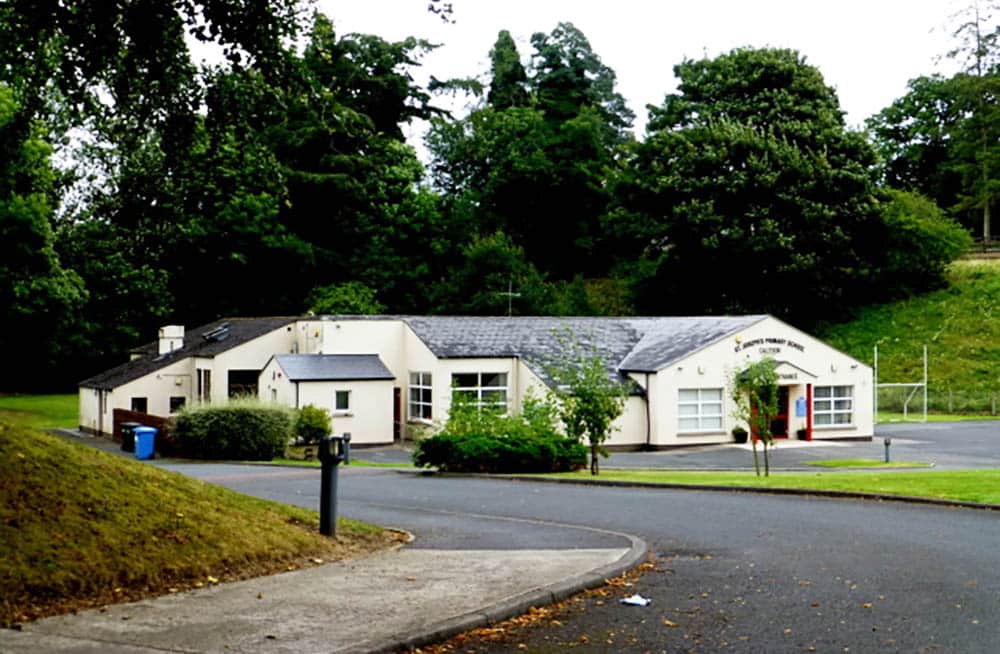
A popular Co Tyrone primary school – described as a ‘beacon of hope’ – has been earmarked for closure, despite fears of the impact on the life of a rural community.
St Joseph’s Primary, on the Derrycourtney Road in Caledon, has been judged as being “unsustainable”.
And, as such, it is intended that the school would close at the end of the summer term – August 31 – in 2027, or “as soon as possible thereafter”.
The intention had originally been that the school would cease to operate next August, but an amendment to that has given a slight stay of execution.
The Catholic Council for Maintained Schools has instructed the Education Authority to publish a development proposal which would see St Joseph’s PS axed after serving the community for many years.
This comes despite it being pointed out during consultations on the proposals that the closure “would leave a substantial rural Catholic community without a local parish school, breaking a link that has existed since 1907”.
Future employment/deployment opportunities would be sought in “alternative schools” for St Joseph’s Primary’s staff, which comprises a principal, two teachers, three classroom assistants, a secretary and building supervisor, if the axe falls.
A pre-publication consultation exercise is now underway, affording those with an interest to make their views known before the actual development proposal is formally published.
The school itself has witnessed a decline in enrolment numbers, from 44 in 2015/2016, to 33 this year.
And estimates are for a further reduction in pupil numbers next year, with an expected enrolment of 28 forecast for 2025/26.
Some insisted the enrolment has been “artificially suppressed due long-standing uncertainty” about the school’s future, with the threat of closure very much to the forefront of the minds of parents in the area considering where to send their children.
The last planned inspection of St Joseph’s, conducted in 2015, found the school to be “very good” for achievements and outcomes and provision for learning and “outstanding” for leadership and management.
The school shares its board of governors with St Mary’s Primary in Aughnacloy.
Amalgamations have been considered and ruled out.
Instead, the pupils who would continue on their primary school journey would be enrolled at various schools in the wider area, with a promise of support to do so.
According to the pre-publication consultation documentation: “The proposal is focused on the challenges facing the area, such as providing the best way to address the educational needs of the pupils, given the population.
“CCMS officers met representatives of St Joseph’s PS, Caledon, and continued dialogue with the Board of Governors, to assess the sustainability of provision and identify any sustainable options available in the area.”
A pre-publication between April and June 2024 was to “discontinue provision at St Joseph’s PS, with effect from 31 August 2025 or as soon as possible thereafter” and “to increase admissions and enrolment at St Mary’s PS”.
CCMS’s Education and Provisions Committee completed a review of the pre-publication consultation materials and responses received and, in September 2024, “agreed to pause the proposal to increase numbers at St Mary’s PS Aughnacloy and proceed to a development proposal for the closure of St Joseph’s PS”.
CCMS notified the stakeholders of this amendment and “provided an opportunity for additional comments” – between November 25 and December 9, 2024 – prior to progressing.
Some responded and argued that ‘pausing’ the increase in St Mary’s PS pupil numbers “fundamentally alters the nature of the proposal consulted upon”, and asked that they should have the opportunity to be consulted with on the amended proposal -closure of St Joseph’s PS.
It was agreed in January this year to proceed to pre-publication consultation on the proposal to “close St Joseph’s PS from August 31, 2026”.
That proposal – which included a deputation from St Joseph’s Primary’s Board of Governors – was heard less than three weeks ago – and it was agreed to proceed with a development proposal, with a revised timescale for implementation of August 31, 2027, or as soon as possible thereafter.
According to a ‘case for change’ paper, the approved enrolment for St Joseph’s PS is 87 and approved admission number is 12.
It was assessed there is “no indication the enrolment in St Joseph’s PS will increase to reach the recommended minimum threshold of 105 pupils” detailed in the Department of Education’s sustainable schools policy.
The case for change states: “The population projections, birth rates in the area and LTE (Long term enrolment) projection are important as they help determine whether there are sufficient pupils to cater for sustainable provision for the area. The data does not suggest there is sufficient demand for a sustainable CCMS primary school for the Caledon area.”
And CCMS was of the opinion there is “insufficient evidence of a potential increase in demand to meet the sustainability enrolment threshold”.
In addition, it was claimed that the school’s annual finances – approved by the Board of Governors – indicate that it “cannot live within its delegated budget”.
In 2024/2025, the average calculated cost per pupil across all CCMS primary schools was £4,400. The average for schools of 104 and below was £5,800 per pupil, and for schools of 105 and above, it was approximately £4,300.
According to figures from the Education Authority, the cost per pupil in St Joseph’s PS was £10,116.
If proceeding with the proposal, after looking at various options, pupils would go to other local schools.
The paper advises: “If a school has no available spaces, they would be supported to accept pupils through the TV process if St Joseph’s PS closed and parental preference was for those schools. It is noted both St John’s PS, Our Lady’s PS and Roan St Patrick’s PS currently operate as seven class base schools and it has been confirmed each has capacity for some additional pupils.
“Derrylatinee PS operates as a four class base school and has capacity for some additional pupils. St John’s PS currently has available places. Our Lady’s PS, Roan St Patrick’s PS, St John’s PS and Derrylatinee PS would be supported to accept pupils through the TV process if St Joseph’s PS closed and parental preference was for one of these schools.”
During an online and written consultation carried out between April and June this year, 23 parents and three Governors expressed their opposition.
Multiple reasons were given for why those responding believed the school should say.
One said the “close-knit nature of smaller schools, like St Joseph’s, also creates a more inclusive environment, where pupils with additional needs can feel supported and understood by both educators and their fellow pupils, without the stigma associated with SEN”.
Another highlighted: “The school provides excellent academic outcomes, pastoral care, and individualised attention is given to pupils.”
More respondents noted the “school fosters confidence, leadership, and extracurricular success (e.g. STEM, Eco-Schools, cross-border projects)” and provided a nurturing environment for pupils who would struggle in larger schools”.
Teachers “are experienced and dedicated” and “provide high-quality educational provision to all age groups in the school”, while the “small teacher:pupil ratio allows the school to observe and act upon concerns related to children’s educational needs if they differ from neuro-typical development”.
Due to the “close relationships forged between staff and parents/guardians, teachers are in a unique position where they can communicate about a child’s progress and any concerns that they may have pertaining to academic and/or social development, facilitating early intervention and improved outcomes for pupils”.
The school’s enrolment “has been artificially suppressed due to long-standing uncertainty about its future” and “families have avoided enrolling children due to fears of closure, creating a self-fulfilling decline”.
Respondents had flagged their belief of a “potential for growth in enrolment due to planned housing developments and the presence of wraparound childcare services”, while Caledon Regeneration Partnership also has a “comprehensive set of plans to regenerate the village and grow the population and services”.
It was argued that Mid-Ulster District Council and the regional planning framework would suggest “the Caledon area requires a viable primary-based school infrastructure to serve the area, meeting all community needs to maintain the longer term viability of the community”.
Caledon was described as a “:very rural area of Northern Ireland, that has limited public transport and services”, and “closing the school in a small rural village or town is not comparable to closing a school in the city”; there were “economic implications of the former, such as the immediate impact on local traders, a reduction in footfall in the village/town on businesses already struggling in the current climate”.
The closure would “leave a substantial rural Catholic community without a local parish school, breaking a link that has existed since 1907”, while it would “exacerbate rural isolation, especially for families without private transport”.
Supporteres of St Joseph’s PS also claimed there was “less availability of school places than the documentation advises”, and “some primary school alternatives are not feeder schools of the usual secondary schools that children from the Caledon/Brantry area go to e.g. St Patrick’s Academy Dungannon, St Joseph’s Donaghmore, St Patricks College, Dungannon or St Ciaran’s College, Ballygawley”.
It was felt too there was a “lack of clarity on transport and transition plans and insufficient exploration of alternatives”.
Pupils were also consulted and “expressed sadness and concern about the potential closure of their school, with many stating they would miss their friends, teachers, and the familiar environment”.
Drawings and written responses “conveyed strong emotional attachment to the school, with references to favourite activities, teachers and memories”.
The school itself had said St Joseph’s was “an integral part of the village and children frequently enjoy Shared Lessons with their counterparts in Churchill PS”; this supported “positive community relationships and drives the strong sense of community pride which exists in Caledon”.
St Joseph’s is “inextricably linked to the Caledon community and beyond” and the majority of children attend Caledon Playgroup prior to starting their formal education.
The school said it has “formed links with many community groups including Caledon Community Centre committee, Caledon in Bloom, Caledon Rovers and with Caledon Estate”, and there is a strong partnership between local businesses and the school.
The school added: “There has been a history of conflict between different traditions in Northern Ireland and Caledon was not immune from this strife. However, the efforts made by both schools, from the two traditions, to build bridges and improve community relationships, has been immense. This work continues and is vital for creating a stable, diverse society.
“St Josephs PS is a beacon of hope, highlighting how the divided society in Northern Ireland can co-exist with their partner school in a spirit of co-operation and mutual respect.”
The CCMS, meanwhile, said it was “committed to ensuring that any transition is managed with sensitivity and care” and, should the proposal proceed, promised to “work with receiving schools to support pupils’ emotional wellbeing and continuity of educational experience”.
It was of the view that “discontinuance of St Joseph’s PS is the most appropriate option to manage the sustainability challenges in the school and area; its decision was taken in the “context of educational sustainability and pupil needs”, where the “primary focus is ensuring sustainable, high-quality educational provision”.
The proposed closure date of August 31, 2027 would “ensure appropriate time for implementation following approval”.
CCMS has said it would liaise with St Joseph’s PS and schools where the pupils would transfer to, assisting – when requested – with the pastoral aspect of the move.
Parents/guardians would have the opportunity to visit alternative schools, meeting with SEN co-ordinators would be organised to facilitate the “efficient and effective” transfer of SEN pupils, and administration of admissions documentation would be organised”.
There would be sufficient time for St Joseph’s to liaise with the Education Authority regarding the “transfer of their assets to other schools and with CCMS regarding secure storage of documents which need to be held”.
The submission adds: “In the event of the closure of the school, employment/deployment opportunities for both teaching and non-teaching staff would be sought in alternative schools.”
There would be “transport assistance for certain pupils” moving to other schools, and this would be mananaged “in accordance with transport policy”.
Further feedback and responses from the Board of Governors and Trustees will now be accepted and considered prior to the publication of a formal development proposal to close and these must be received by January 8 next year.