Residents campaigning against the development of a Heat to Power Plant near Benburb village have launched a public petition following a recent meeting.
The collective known as Residents Against Incineration (RAIN), was established off the back of plans to develop the £9 million plant put forward by local environmental engineering firm, AIC Group, back in December 2025.
When AIC Group – based on the Milltown Road near Benburb – first expressed their plans to construct the combined heat to power thermal treatment centre at the rear of their existing site it was met with fierce public opposition.
Despite the company arguing they have done all they can to assuage public concern by “being upfront”, acknowledging concerns as “perfectly valid” and hosting several public consultations, that opposition continues to mount.
Residents’ primary concerns surrounded the emissions produced by the facility – and if these will be pollutant – air pollution by the way of possible odour produced by waste combustion, visual impact through the accumulation of waste on site and the type of waste to be handled on site… particularly surrounding the feeding of medical waste from hospitals.
Related: First official step taken by Benburb firm with hopes of building contentious heat to power plant
AIC Group had engaged of their own volition with the public but up until April of this year had not submitted any formal plans for the proposals to Council.
Following submission of a Pre-Application Notice (PAN) in that month – which has been deemed as ‘acceptable’ by council -, RAIN has again met to discuss how they intend to move forward.
The meeting held on May 14 at Benburb Priory saw attendees outline a new public petition to garner signatures in support or objection.
Within the first 24 hour period, the petition had gathered over 200 signatures; it has since got over 600.
Describing the petition, RAIN say, “This campaign is about standing together as a community to protect our environment, our countryside, and future generations from a development that could have lasting impacts on local health and air quality.
“We, the undersigned, call on our political representatives and statutory authorities to reject this application, protect public health, respect and address the concerns of the local community.”
They make the clear distinction, “this petition is NOT a formal planning objection. It is intended for political lobbying purposes only — to demonstrate the strength of public feeling and show decision-makers just how many people in our community oppose this proposal.”
Related: Benburb: Proposals for two heat to power plants just miles apart polarise opinion
With that in mind, they continue to encourage those wishing to make formal objections to any future planning applications to do so via the NI Planning Portal directly.
AIC Group has always vehemently stressed that their proposals are for a Heat to Power Plant – rather than an incinerator – and that there are, in their view, several positive factors to its development to consider.
Previously, the company signalled a potential jobs boost as a result of their multi-million pound investment, if approved.
Of the job creation, a company director explained: “We would need in the region of 16 people. That’s full-time. We employ 24 to 26 at the minute and then we would have to bring on six more in the near future; they would be kept on and then four to six on top of that would be needed to facilitate the facility fabrication which would all then be sustained and then 13 to 16, roughly, to help with general service, maintenance, house-keeping, admin and management.”
They also argue the facility would see a significant reduction in their company’s carbon footprint.
The petition can be viewed here.
Response from AIC Group
AIC Group has always and continues to welcome scrutiny of the proposed development and fully respects the right of residents to object.
However, objections should be based on the facts of the actual proposal, not hearsay, assumptions, emotive labelling or comparisons with unrelated facilities elsewhere.
We respect the right of campaign groups to organise, petition and encourage participation in the planning process. It is entirely proper for residents to familiarise themselves with planning policy, seek advice, lobby representatives where appropriate and submit representations.
Our concern is not that people may object it is that objections should be accurate, specific and based on the actual development proposed. Residents are entitled to hear both concerns and answers.
In relation to this we would like to address that, to date, despite numerous attempts to facilitate constructive and structured interaction we have received no contact from the recently established community group “RAIN”, either on its own behalf or as a representative of the local community nor have we received contact details for any representatives within.
We cannot answer questions that we are not invited to answer nor can we participate in discussions surround the proposed development if we are not included. These facts have directly exacerbated the level of public uncertainty and speculation surrounding our proposed development.
At our latest public consultation event, we prepared a second detailed Community Engagement Meeting Information booklet which totals 60 pages and expands in detail on questions raised at the first AIC Group organised community consultation event.
Multiple copies of this booklet were provided to a “RAIN” organiser at our latest event for distribution to the local public, this booklet addresses many of the questions and comments now being repeated publicly, including waste acceptance, emissions, monitoring, odour, traffic, water protection, fire prevention, residues, planning policy and environmental permitting. It is disappointing that this information has not been acknowledged, reflected up or indeed distributed within the community group.
AIC Group have never avoided public scrutiny. What we ask is that the public discussion and evaluation of the proposed development is based on the actual Combined Heat and Power Waste To Energy proposal not on speculation, selective comparisons or misinformation.
AIC Group is a family-owned and operated Northern Ireland manufacturing business based at 113-115 Milltown Road. Its core business is the design, manufacture, installation and maintenance of thermal treatment and waste-to-energy systems.
The current proposal is directly linked to that existing business and is intended to support manufacturing growth, skilled employment, technology demonstration, energy recovery and selected local waste-treatment resilience.
Contrary to statements made on social media and at the recent meeting by the event organisers the previous Planning Application Notice (PAN) that was submitted was not deemed invalid, the proposal was updated following site review and engagement with council planning representatives, including changes to the proposed development to ensure compliance with planning and environmental legislation, minimise impact on the local area in relation to building scale and positioning and a change of legal site address. A fresh consultation process was then commenced so the public could consider the updated proposal, which is the correct approach.
Where a proposal changes materially, it is better to restart consultation and allow residents to review the current proposal than to proceed on the basis of outdated information.
The purpose of the current consultation period is to explain the revised proposal, receive feedback and address any and all comments.
The updated proposed development has two linked but distinct parts.
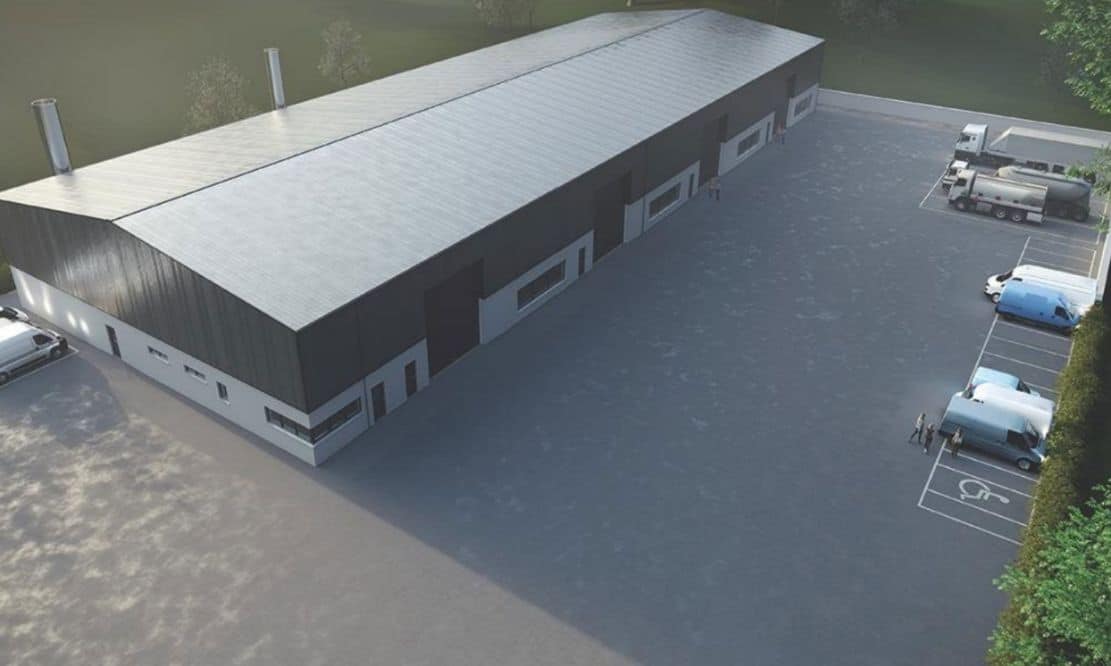
The first is a manufacturing growth extension to support AIC Group’s existing business of designing, manufacturing, installing and maintaining Thermal Treatment and Waste To Energy Systems. The second is the reuse of the existing former on-site tyre recycling building, with a modest extension, to house an in-house AIC designed and manufactured Combined Heat and Power Waste To Energy system.
This revised approach was brought forward following engagement with planning representatives and reduces the amount of new built development required by making use of existing brownfield industrial infrastructure in line with relevant planning legislation.
The final waste acceptance list would be determined through the environmental permitting process, including waste codes, quantity limits, packaging requirements, storage requirements and operating conditions. Waste acceptance would involve pre-acceptance review, classification, approval before delivery, reception checks, sealed containers, internal unloading, internal storage and record keeping. Non-conforming or unauthorised waste would be rejected or quarantined or removed.
Our proposal is based on the waste hierarchy and is intended for selected residual waste streams unsuitable for reuse or recycling, not to compete with these. We take note that a selection of local residents present at the meeting have commented that the proposed facility could “start off as small and expand greatly at a later date” as well as claims that “waste from mainland Europe would be imported as infeed material”.
These points are valid queries, we would like to take this opportunity to once again formally and clearly state that the facility will process a maximum of one tonne per hour of infeed waste material and at no time will an increase in facility size and or infeed material throughput be sought from installation to end of life of the system. Nor shall waste be imported from mainland Europe as an infeed material over the course of the systems lifespan.
We believe health, emissions and environmental concerns must be treated seriously, but assessed through evidence specific to the proposed facility. Concerns about prevailing wind, the Blackwater Valley, nearby homes, farms, livestock, crops, heritage assets and ecological receptors are matters for planning, environmental permitting, air quality assessment, dispersion modelling and independent public health assessments which will all be submitted with the full planning application.
Broad ranged derogatory claims have been issued at the meeting in relation to public health, Lough Neagh ammonia loading or heavy metal contamination which are unfounded based on this specific project and the information available for evaluation. In relation to this, we wish to convey that the stack should not be understood as an open chimney releasing untreated smoke or emissions.
Flue gas would pass through controlled combustion, high-temperature secondary flue gas treatment, heat recovery, dry reagent-based flue gas cleaning, ceramic filtration, induced draught control and monitoring before discharge through a designed stack. Monitoring requirements would be set by the environmental permit and may include dust, carbon monoxide, nitrogen oxides, sulphur dioxide, hydrogen chloride, organic carbon, oxygen, temperature, pressure, flow, heavy metals, dioxins and furans but it must be noted that emissions monitoring is a constant 24/7 requirement, not an option on the proposal system which links into automatic interlocks to prevent continued operation in the event of an emergency.
Concerns have also been voice in relation to water, residues, odour, vermin and fire risk. The proposal does not include the discharge of process water directly to a watercourse or to the ground. Water from relevant internal areas as a result of general housekeeping activities would be collected and removed by tanker to an authorised water treatment facility in line with environmental legislation. Bottom ash and flue gas treatment residues would be collected, tested, classified and managed under waste legislation and permit requirements which would see bottom ash sent for re-use in the aggregates industry whilst flue gas treatment residues would be sent for hazardous processing, both are a small percentage of system feedstock throughput.
Waste feedstock would arrive in sealed containers, bins, drums, IBCs or other enclosed units, with unloading and storage taking place internally. No external waste feedstock storage or open stockpiling is proposed. Fire prevention would be addressed through controlled acceptance, suitable storage, segregation where required, housekeeping, staff training, emergency procedures and fire detection and firefighting arrangements subject to our fire risk assessment.
Traffic and road safety seem to have featured strongly in the public discussion. Currently a number of businesses operate via the current AIC Group site access road which is the same as the planned access for the proposed development, all AIC Group team members ensure that the necessary due care and attention is implemented when transiting to and from our site and we wish to convey that we cannot control the actions of other unrelated road users outside of our property boundary.
Access, road condition, visibility, HGV routing, internal circulation and safety for residents and children are important to us and an important consideration in planning matters, but the proposal should be judged on the traffic it is expected to generate, and the traffic statistics within the local area.
The proposed development will generate approximately six HGV movements per day between 7.00am and 6.00pm, Monday to Saturday.
The site previously operated as a road haulage and distribution centre and, at historic peak activity, is understood to have generated approximately 35 to 45 vehicle movements per day, seven days per week. We will engage with the relevant authorities on routing, visibility, internal vehicle management and any traffic management measures considered necessary and are prepared to implement physical road improvements if required in connection with the department for infrastructure.
Questions have also been raised about noise, operating hours, grid export, technical reports and regulation. Noise will be assessed against existing background conditions and nearby receptors through an independent third-party report.
The system is designed to recover useful energy from the selected residual waste streams, electricity and heat would be used first within our own manufacturing operations, with any surplus electricity exported to the national grid subject to technical approval, grid capacity, metering and regulatory requirements. The proposed development does not include expansion of the electrical grid infrastructure, only a connection internal on our existing site.
Statements have also been made in relation to the justification of our proposed development economic benefit, in particular job creation.
It must be made clear that existing employment within the manufacturing division of the company will be retained and added to, not replaced by the new positions available from the proposed development.
To conclude, AIC Group’s position remains that we respect the right of residents, farmers, elected representatives and community organisations to scrutinise and indeed object where they feel applicable to the proposed development. However, objections should be accurate, evidence-based and directed at the actual proposed development no based on hearsay, emotive labelling, speculation, or conclusions drawn from unrelated projects elsewhere.
We will continue to engage openly and professionally at every opportunity presented to us and the company remains committed to manufacturing growth, brownfield reuse, local employment, export development, controlled residual waste treatment, energy recovery and compliance with all applicable planning and environmental requirements.
Most read today
PUBLIC NOTICE