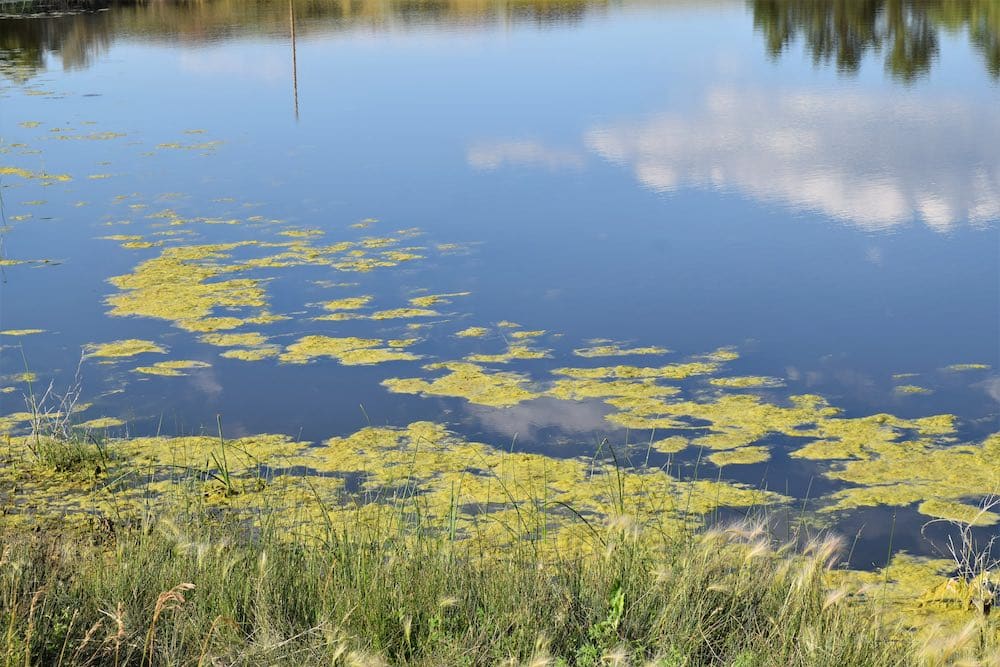
With temperatures again poised to hit the mid-20s and schools now out for summer, there has been some far from good news for families planning a visit to Loughgall Country Park.
For blue-green algae – which can pose dangers to both pets and humans – has been confirmed within the picturesque County Armagh park.
Warning signs have suddenly appeared to advise people of the ‘do’s and don’ts’ following the discovery.
The Department for Agriculture maintains a database of areas where the presence of blue-green algae has been confirmed, regularly providing updates on latest locations.
ABC Council – or the local authority in each area – then acts to put in place signs after such confirmations are made.
Armagh I contacted ABC Council on Monday morning after the appearance of yellow warning signs were highlighted by visitors at the weekend.
And a spokesperson confirmed later that day: “We have now received confirmation of the presence of blue-green algae at Loughgall Country Park.”
By Monday afternoon, there were 77 confirmed reports of blue-green algae across Northern Ireland, the most recent locally – before Loughgall – being at Clay Lake, near Keady, late last month.
The lake at Loughgall Country Park is popular with anglers and dog walkers.
The advice on the yellow warning signs – among other things – urges people not to eat fish taken from the lake and to keep animals, including pets and livestock, away from the water.
ABC Council, meanwhile, has shared guidance for the public, saying the arrival of summer weather presents a good time to highlight the dangers posed to humans and pets by blue-green algae and the importance of reporting any sightings.
A spokesperson said: “As a precautionary measure, warning signage will be erected at sites where blue-green algae has been detected, to warn visitors of its presence and advise that adults, children and animals should avoid contact with the algae and the water close to it due to its harmful effects.
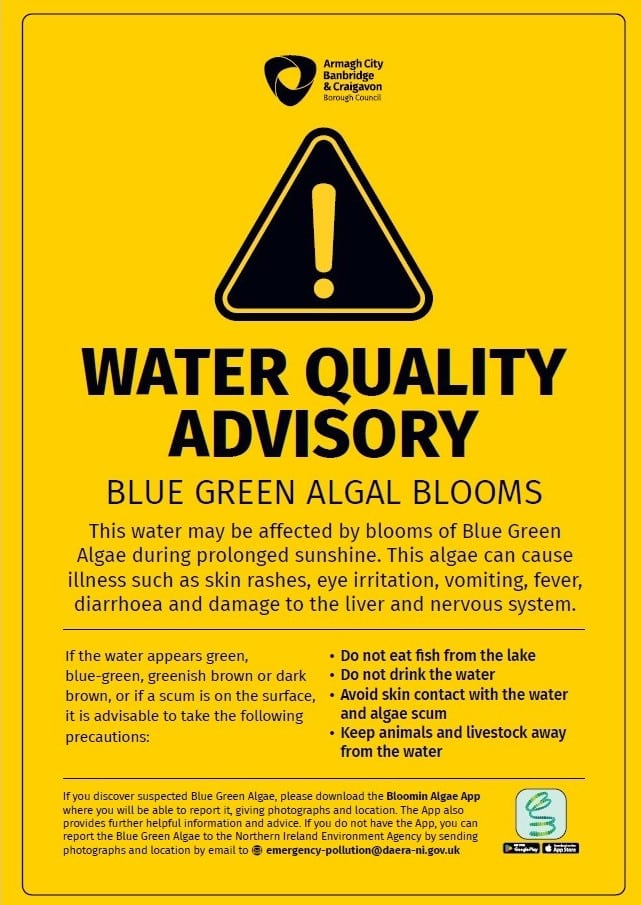
Warning signs like this have been erected at Loughgall Country Park.
“Swallowing the water can cause stomach upsets or severe illness to people and death to animals. Contact with the water or the blue-green algae can also cause rashes and skin problems.”
Blue-green algae are natural inhabitants of many inland waters, estuaries and the sea. Although referred to as algae they are, in fact, a type of bacteria – known as cyanobacteria – with the ability to use the sun’s energy to make food in the same way that many plants do.
They may be found in suspension, attached to rocks and other surfaces at the bottom of shallow waterbodies and along the edges of lakes and rivers. The term blue-green algae includes a number of different species.
All species of blue-green algae need nutrients – nitrates and phosphates – to grow. If the water is enriched with nutrients and there is calm, sunny and warm weather conditions, then the growth may become excessive resulting in algal blooms.
These algal blooms cause the water to appear discoloured green, blue-green or greenish-brown and some species can produce a musty odour. When the blooms die, they break down, using up oxygen in the water and cause problems for other aquatic life, such as fish.
In calm, warm weather, some bloom-forming species will rise to the water surface and form a scum which may again be coloured.
For reasons not fully understood, some bloom and scum-forming blue-green algae are capable of producing toxins. Although many blue-green algae blooms are not toxic, some produce nerve or liver toxins and it is therefore safest to assume toxins could be present.
In their most dangerous form, both in quantity and species, blooms have caused death in cows, sheep and dogs drinking significant concentrations at the water’s edge.
According to council guidance: “Human health risk from exposure to blue-green algae toxins can arise through swallowing or inhaling water containing the algae and through prolonged direct contact with exposed parts of the body including the skin, and sensitive areas such as ears, eyes, mouth and throat.
“Different groups of water users are at different levels of risk, depending on the amount of time they are likely to spend in/close to the affected water.”
This includes swimmers, paddlers, children playing at the water’s edge, dogs, other animals including some farm animals, fishermen using the bank and water’s edge; windsurfers whose level of competence puts them at risk in the prevailing wind conditions of becoming immersed in or blowing into areas of algal scum; and dinghy sailors, catamaran sailors, canoeists and windsurfers competent for the prevailing conditions, as well as other boat users and fishermen fishing from a boat or pontoon.
“Essentially, the more likely you are to come into direct contact with the algal scum, the greater the risk of effects of exposure,” according to advice. “Symptoms of those affected could be easily confused with a range of other illnesses so it is important to be aware of the risk of blue-green algae as a contributory factor.
“Swallowing and/or inhalation can result in mouth and nose ulcers, blistering of the lips, abdominal pain, nausea, vomiting, diarrhoea, muscular pains, sore throat, dry cough, headaches, hay fever symptoms, dizziness and fatigue.”
Members of the public are advised to report concerns using the Bloomin’ Algae App to help provide a rapid and more comprehensive picture of harmful algal blooms in the area and inform the relevant environment agency, local authority or landowner.
Alternatively you can visit, click www.ceh.ac.uk/our-science/projects/bloomin-algae