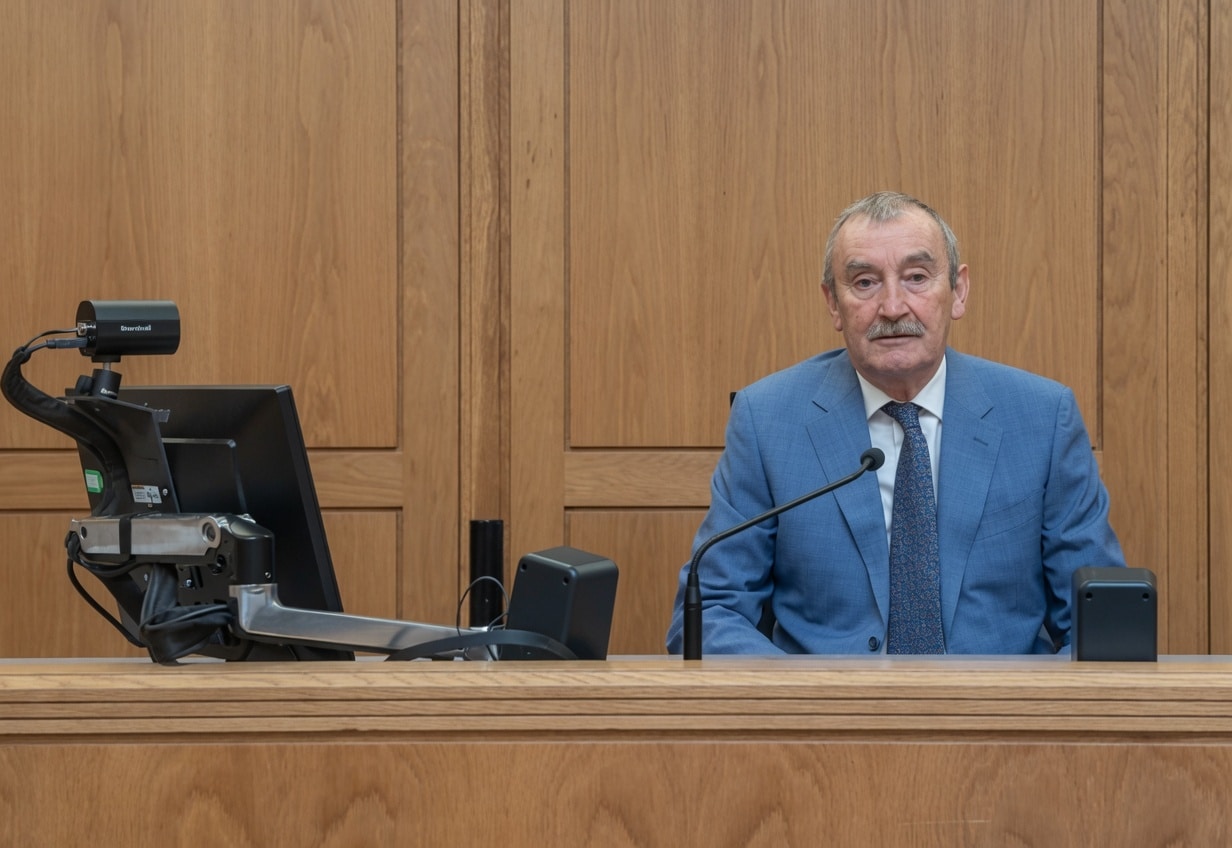
It was an emotional day at Newry Magistrates’ Court on Friday as colleagues and friends gathered to bid farewell to District Judge Eamonn King, who retired after twenty-one years in the role.
Before proceedings began, Judge King spoke to Armagh I about his career in law, his time on the bench, and the experiences that shaped his journey.
One of thirteen children, Eamonn King grew up on a small dairy farm in Castlewellan, Co. Down. After graduating from St Patrick’s Grammar School in Downpatrick, he went on to study law at Queen’s University Belfast.
However, a career in law was not always his ambition.
“I wanted to be a vet,” he explains. “To do veterinary, you had to either go to Dublin, Liverpool, or Glasgow, and I applied to all of those, but I didn’t get an answer. I thought I hadn’t got in. I’d got an offer [to study law] from Queen’s, so I accepted it, and after I accepted the offer, the offer to do veterinary came through from University College Dublin!”
Despite the unexpected turn in his career path, Judge King says he has no regrets about the decision he made.
“From the minute and hour I went to Queen’s, I just felt it was pre-destined,” he says.
After qualifying as a solicitor with The Law Society in the early 1980s, he established his own legal practice.
“My first job was to get a tree preservation order for two copper beeches on the Lurgan Road in Banbridge. They’re still there!” he says.
“It was a good time to set up a private practice,” he explains. “We were at the heart of The Troubles, and there was a serious need for legal representation.”
Related: Tributes flow as Newry’s ‘fair and kind’ Judge King retires after two decades on the bench
Judge King believes solicitors played a vital role in maintaining public confidence in the justice system during this period.
“The glue that kept society together at that stage in Northern Ireland, with all that was going on – the sectarianism, the bombings, the killings – was that if someone was charged, they could pick who represented them in court,” he explains.
As a solicitor, Judge King saw it as his responsibility to provide representation to anyone who sought his help, regardless of their background.
“If someone took the trouble to come through my door looking for advice and representation, it was my duty to do my best for them, whoever they were,” he says.
In 1998, after several years practising law, Judge King decided to apply to become a Deputy Resident Magistrate.
Taking his place on the bench, he viewed his farming background as an advantage when handling the cases before him.
“It was challenging,” he says, “but I suppose the way I dealt with it was I applied my common sense and my life experience to the situation that was presented to me.”
In June 2005, Judge King was appointed as a full-time District Judge, leaving behind his private practice.
Over the years, he has witnessed a wide range of cases and says that, ultimately, people remain at the centre of his work.
“We are at the very base level of the administration of justice,” he explains, “and really, it’s mostly about people and how they relate to one another.”
One of the cases Judge King remembers most fondly from his time on the bench involved a thirteen-year-old girl.
“She was up for serious assaults, assaults on police, assaults on family members,” he explains. “Eventually she ended up in foster care.”
Rather than punishing the girl, Judge King decided to conditionally discharge her.
She went on to find stability with foster parents, and on the day Judge King was due to end her care order, she was asked if she would like to speak to the court.
“She said she didn’t want to come to court,” he explains, “but she’s perfectly happy with what I decide, and she called me a cool dude.”
“Since that time, she’s been in long-term foster placement,” he says. “And I have a card at home where she wrote a letter to me thanking me for persevering with her, allowing her to get to where she is now.”
Giving people a second chance is central to how Judge King believes a magistrate should approach their role.
“My role gives me authority to deal with people,” he says. “I like to think that I use that authority to listen, to understand, to console, to direct, and to help people make better choices. And the one word I wouldn’t use is punish.”
On another occasion, Judge King was faced with a man charged with “serious offences in relation to members of the public”.
The man’s solicitor spent almost thirty minutes trying to persuade Judge King to take a more lenient approach to sentencing. After learning that the man’s background was “horrific”, Judge King decided not to send him to prison.
“I gave him a chance, and that boy did turn himself around,” he explains.
“He’s back out there, running his own business. And again, I got a thank you card from the parents…to say thanks for taking the time to listen and try to understand. Now, is that not better than locking somebody up for six months?”
Perhaps the most high-profile case Judge King presided over during his career was the trial of Jeffrey Donaldson earlier this year.
Despite the attention surrounding the case, Judge King says it was, for him, simply another day in court.
“It was no different to any other case that I deal with on a daily basis in Newry,” he explains.
“Every person appearing in court is entitled to be dealt with in a respectful, professional manner, treated with dignity and in accordance with the procedure set down, and that was no different for Jeffrey. It was an ordinary day in Newry Court.”
Judge King describes Newry Courthouse as “the jewel in the crown of the criminal justice system”.
“That’s down to the staff, right from the front door right down to the cells,” he explains.
“There’s a collegiality here that, when I travel, I don’t see anywhere else, and it’s a family. And I’ve been so fortunate to be part of that.”
After more than two decades on the bench, Judge King plans to return to his roots during retirement.
“I have a small farm,” he explains. “I’m going to give it the attention that it deserves.”
He also hopes to spend more time with his family.
“I also have two grandchildren – hopefully I will have more – and I want to help my daughters rear those grandchildren, and I hope to remain in good health to do so.”
As he prepared for his final day in the role, Judge King admitted that he “got emotional”.
With tears in his eyes, he says he could not have asked for a better career.
“I have absolutely enjoyed this job,” he says. “This was the best thing that ever happened.”