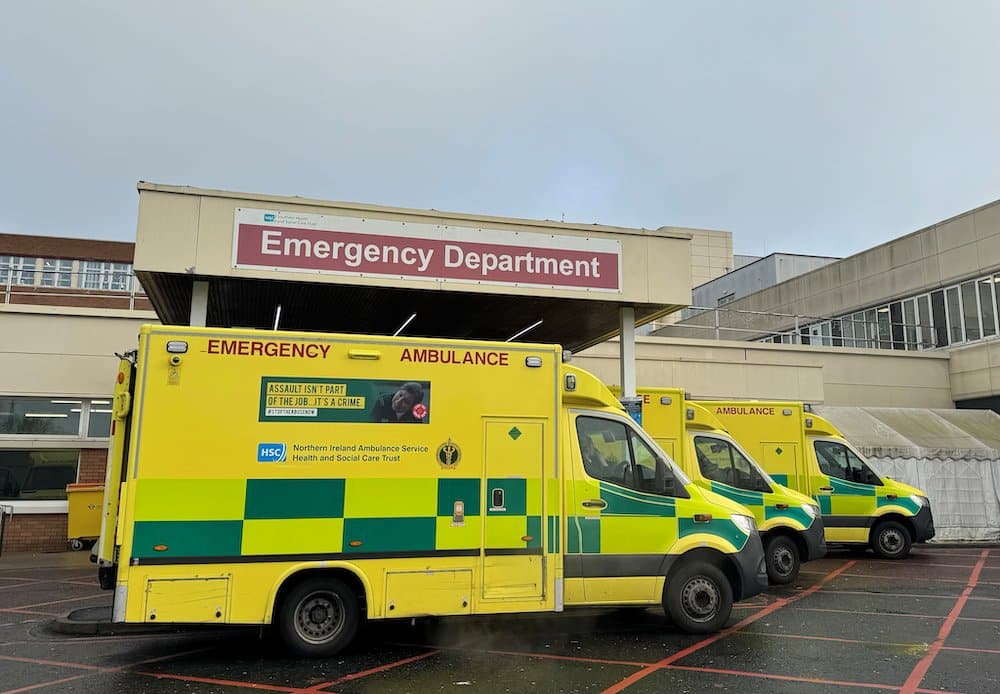
Ambulance handover delays have reached crisis point, with stroke patients having to wait two hours and 29 minutes on average for an ambulance.
And while the response time is nowhere near the 18-minute target for this category of patients, the situation was even worse only a few weeks ago, when stroke patients had to wait over three hours for paramedics to reach them.
The information was revealed by Interim Chief Executive of the NI Ambulance Service (NIAS), Maxine Paterson revealed at last Thursday’s (January 29) board meeting of the Southern HSC Trust.
She told board members: “NIAS fully recognises that ambulance handover delays [are part of] a much wider system challenge, discharge [issues], bed availability and community capacity.
“There’s no single fix and there’s no single organisation that can solve this in isolation.
“What I want to achieve is a renewed and resilient focus on improving ambulance handover for the Southern community, because the impact on patients, staff and the system resilience is now too significant to be accepted as the new normal.
“Ambulance handover delays create harm. Once handover exceeds 60 minutes, harm is no longer exceptional for patients, it is expected.
“We’re talking about very real human consequences, we’re talking about deterioration in unmanaged pain. It is much more difficult to support patients who are waiting a long time.
“Dehydration, pressure damage on really unsuitable trolleys for long waits, and not the same trolleys as what you have in your Emergency Departments (EDs).
“So, it can be really uncomfortable, especially for those patients who are frail, elderly, and with dementia.
“If you’re over 80, and you’re conveyed by ambulance to an Emergency Department, the average length of stay is 15 days, regardless of why the ambulance has conveyed you to hospital. That’s a really staggering piece of information that has surfaced.
“Ambulance handover delays are a patient safety and dignity issue.
“There is also another dimension of harm, about the significant increase in SAIs (Serious Adverse Incidents).
“Even when causation is not established, uncertainty persists. For families, the question of whether something would have changed the outcome, had we got there earlier, persists.
“This is not about apportioning blame, or NIAS adopting some kind of defensive posture, it’s about recognising the emotional burden that the system places on patients, families and staff – not just our staff, but the ED staff.
“That’s why prolonged handover delays cannot be allowed to drift into normality.
“In December alone, 11,072 hours were lost in EDs due to handover delays. That equates to 30 ambulance shifts per day not reaching the community, and around 26 per cent of our planned emergency capacity lost.
“These are hours where we have highly-trained crews sitting outside EDs, rather than responding to the next 999 call.
“Response times are impacted quite significantly. This week, our average response time to [reach] one patient is around 13 minutes, and that’s for people who are not conscious and not breathing.
“Our major response category is Cat 2 (Category 2). It is for people who experience chest pain and stroke symptoms.
“Our response time this week is two hours and 29 minutes to [reach] people who are having chest pain or stroke symptoms, and the standard is 18 minutes. So, that’s how far we are away.
“I would say this week is actually a significant improvement on a few weeks ago, when we were at 182 minutes for Cat 2, and that is really challenging.”