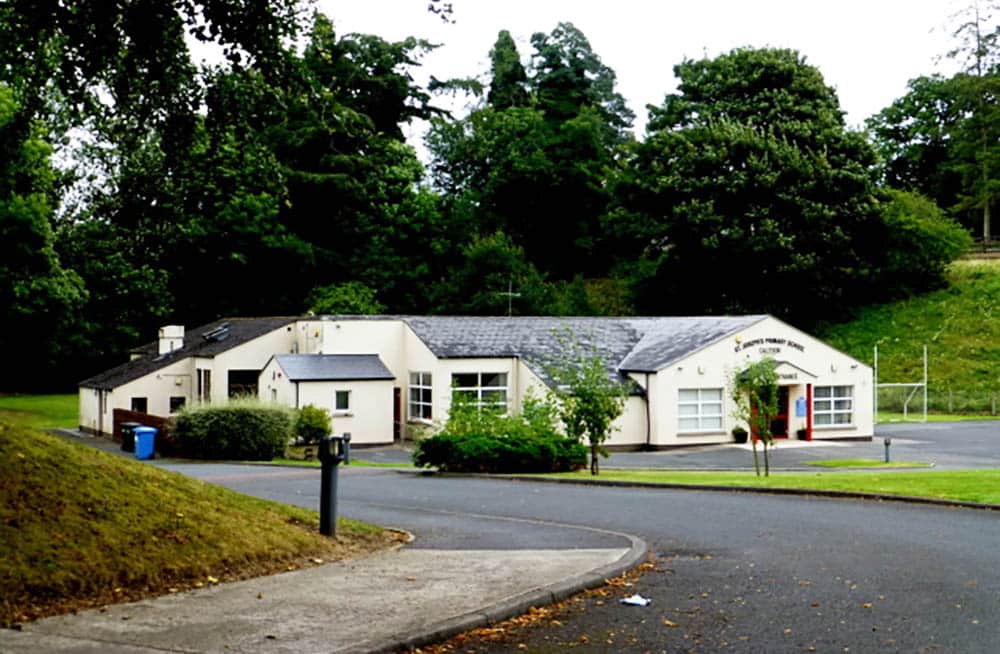
A formal proposal to close St Joseph’s Primary School in Caledon has now been made, despite objectors imploring: ‘Please do not shatter our hopes and dreams in the future of our community.’
A pre-publication consultation was launched in November last year, with the school earmarked for the axe at the end of the summer term – August 31 – in 2027, or “as soon as possible thereafter”.
A copy of the proposal – and accompanying case for change – was sent to 16 local schools which, in the opinion of the Education Authority, might be affected.
Comment was also encouraged from the Boards of Governors and Trustees, with a deadline early in January.
One joint response from the affected schools was received by the Education Authority. A further 15 objections – 11 of them from parents – were also lodged within the timeframe.
The Catholic Council for Maintained Schools had instructed the Education Authority to publish a development proposal which would see St Joseph’s PS axed after serving the community for many years.
It came despite it being pointed out during consultations on the proposals that the closure “would leave a substantial rural Catholic community without a local parish school, breaking a link that has existed since 1907”.
The school itself has witnessed a decline in enrolment numbers, from 44 in 2015/2016, to 33 this year.
And estimates are for a further reduction in pupil numbers next year, with an expected enrolment of 28 forecast for 2025/26.
Some insisted the enrolment had been “artificially suppressed due to long-standing uncertainty” about the school’s future, with the threat of closure very much to the forefront of the minds of parents in the area considering where to send their children.
Multiple reasons were cited across all responses on why objectors believed the school should be retained, including the impact on St Mary’s Primary School in Aughnacloy, with which St Joseph’s shares its Board of Governors.
It was pointed out that St Mary’s Primary’s enrolment was growing and it is “probable that the closure of St Joseph’s PS will place additional pressure” on the school, “which does not have the physical infrastructure to cope and impact on the provision of education for the children of Aughnacloy”.
Fears were also voiced that the closure would “destroy educational provision and community links established over generations and negates parental choice”.
There was “concern regarding increasing class sizes in alternate schools within the area and potential use of dinner hall/canteen as teaching spaces”.
Other objections – and reasons to keep St Joseph’s – argued thus: “The proposed closure would have a significant negative impact on pupils and families. Many children would be required to travel longer distances to alternative schools, increasing journey times and placing additional pressure on young children. As working parents, increased travel distance would place significant strain on our family, creating challenges around childcare, work commitments, and daily routines
“The school provides stability, support services, and a sense of belonging in a village where Catholic people have previously been a minority and just making progress in cross-community relations and a more equal religion population.
“The decades of work on the peace process and work on equality cannot be disregarded by transferring students to already crowded schools, making families leave the parish they live in.
“The school provides a high quality of education and commitment from the school goes beyond expectations.”
It was pointed out that St Joseph’s PS and Churchill PS take part in Shared Education activities regularly, in both schools and with the Speedwell Trust in Parkanaur.
Objectors add: “Schools in the village are working hard to get pupils to forge relationships at a young age, so the foundation is there when they are teenagers and adults to prevent tensions between our religions in the future. So much effort has been put in to maintain relations in the village to promote peace and friendship.
“Please do not shatter our hopes and dreams in the future of our community.
“Schools in the village have been pivotal in creating an environment which is inclusive and diverse. The removal of St Joseph’s PS would be the beginning of a reversal in relationships. We would see the Catholic population diminishing and potentially becoming a minority and marginalised.”
It was “strongly argued” that the future of St Joseph’s PS needs to be considered in the broader context; there were “important
social, economic and indeed political circumstances to be taken into account”. The approach to area planning of recommending closure for schools below the stated sustainability thresholds for pupil numbers – or financial position – was “far too narrow and should not apply in this case”.
The development proposal was discussed by the Education Authority’s Strategic Planning and Policy Committee at the start of February.
And, having done so, the Education Authority decided it “supports the Council for Catholic Maintained Schools in taking forward the development proposal”, which was to close St Joseph’s PS “with effect from 31 August, 2027, or as soon as possible thereafter”.
In the earlier case for change, the school had said it was “inextricably linked to the Caledon community and beyond” and the majority of children attend Caledon Playgroup prior to starting their formal education.
The school said it has “formed links with many community groups including Caledon Community Centre committee, Caledon in Bloom, Caledon Rovers and with Caledon Estate”, and there is a strong partnership between local businesses and the school.
The school added: “There has been a history of conflict between different traditions in Northern Ireland and Caledon was not immune from this strife. However, the efforts made by both schools, from the two traditions, to build bridges and improve community relationships, has been immense. This work continues and is vital for creating a stable, diverse society.
“St Josephs PS is a beacon of hope, highlighting how the divided society in Northern Ireland can co-exist with their partner school in a spirit of co-operation and mutual respect.”
The CCMS, meanwhile, said it was “committed to ensuring that any transition is managed with sensitivity and care” and, should the proposal proceed, promised to “work with receiving schools to support pupils’ emotional wellbeing and continuity of educational experience”.
It was of the view that “discontinuance of St Joseph’s PS is the most appropriate option to manage the sustainability challenges in the school and area; its decision was taken in the “context of educational sustainability and pupil needs”, where the “primary focus is ensuring sustainable, high-quality educational provision”.
The proposed closure date of August 31, 2027 would “ensure appropriate time for implementation following approval”.
CCMS has said it would liaise with St Joseph’s PS and schools where the pupils would transfer to, assisting – when requested – with the pastoral aspect of the move.
Parents/guardians would have the opportunity to visit alternative schools, meeting with SEN co-ordinators would be organised to facilitate the “efficient and effective” transfer of SEN pupils, and administration of admissions documentation would be organised”.
There would be sufficient time for St Joseph’s to liaise with the Education Authority regarding the “transfer of their assets to other schools and with CCMS regarding secure storage of documents which need to be held”.
The submission adds: “In the event of the closure of the school, employment/deployment opportunities for both teaching and non-teaching staff would be sought in alternative schools.”
There would be “transport assistance for certain pupils” moving to other schools, and this would be mananaged “in accordance with transport policy”.
The formal development proposal now published, anyone wishing to object or support the closure should do so by contacting the Area Planning Policy Team, Department of Education, Rathgael House, Balloo Road, Bangor, Co Down, BT19 7PR or by emailing dps@education-ni.gov.uk. The deadline for receipt of responses is April 2, after which feedback will be considered and a final recommendation and decision taken.