A secondary school just off the Garvaghy Road will remain closed on Monday as tension continues to hang over Portadown following an extraordinary day of stand‑offs, legal wrangling and political rows around the Drumcree parade.
St John the Baptist College and its nursery announced it would not open “due to recent developments on the Garvaghy Road”, saying the safety and welfare of its school community “remains our priority”.
“These are unprecedented times and there is a real sense of fear and anxiety in our community at present,” the nursery said in a statement. “We pray that everyone stays safe over the coming hours and days.”
St John the Baptist College also confirmed on social media that it too will be closed on Monday, citing “the escalating situation on the Garvaghy Road this afternoon”.
“Dear parents, in the interest of everyone’s safety and the escalating situation on the Garvaghy Road this afternoon, the decision has been made to CLOSE the school, tomorrow, Monday 28th September. We apologise for any inconvenience,” the college said.
The closures underline how uncertainty and fear around the disputed parade route are now directly impacting everyday life for local families.
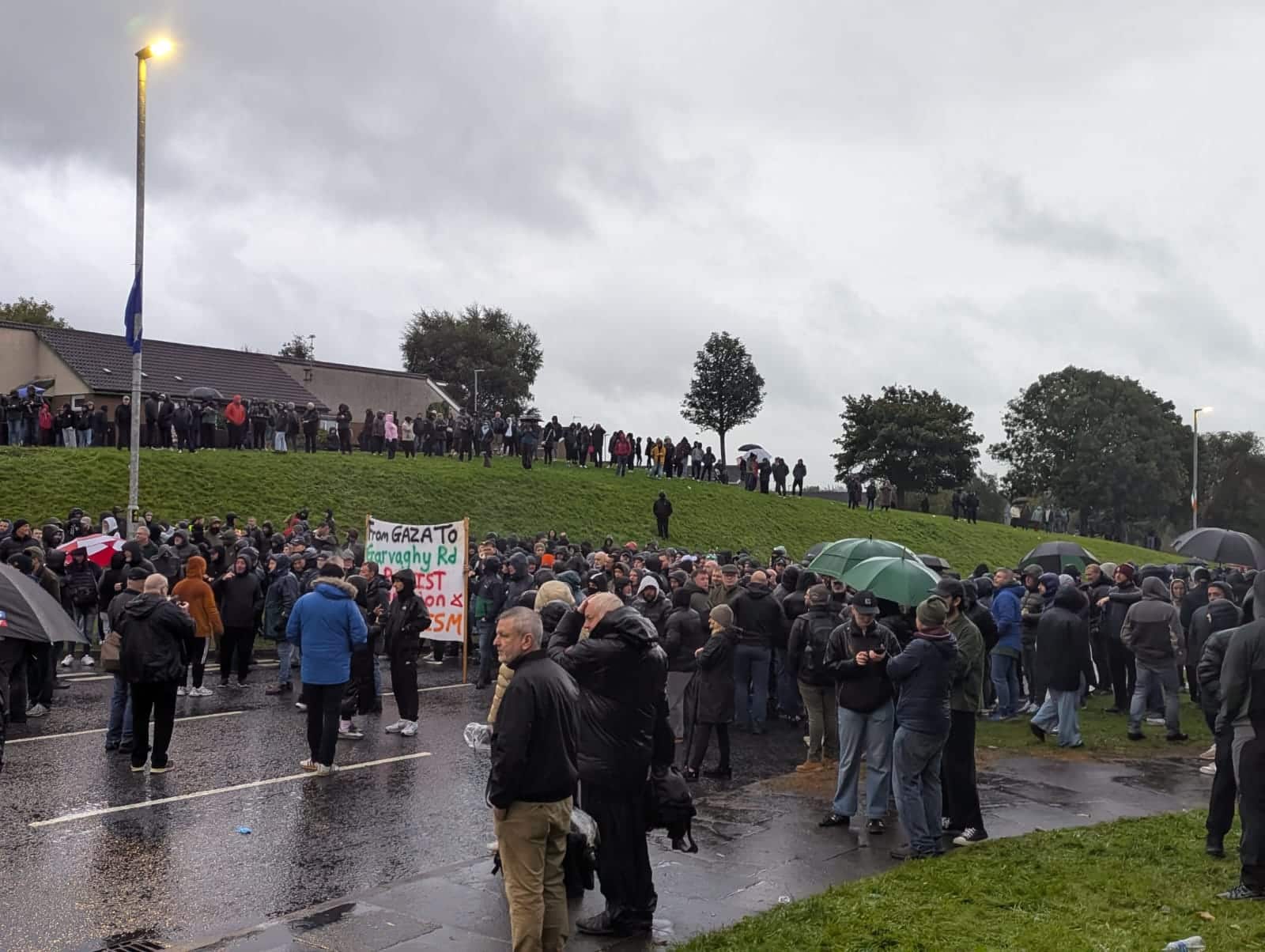
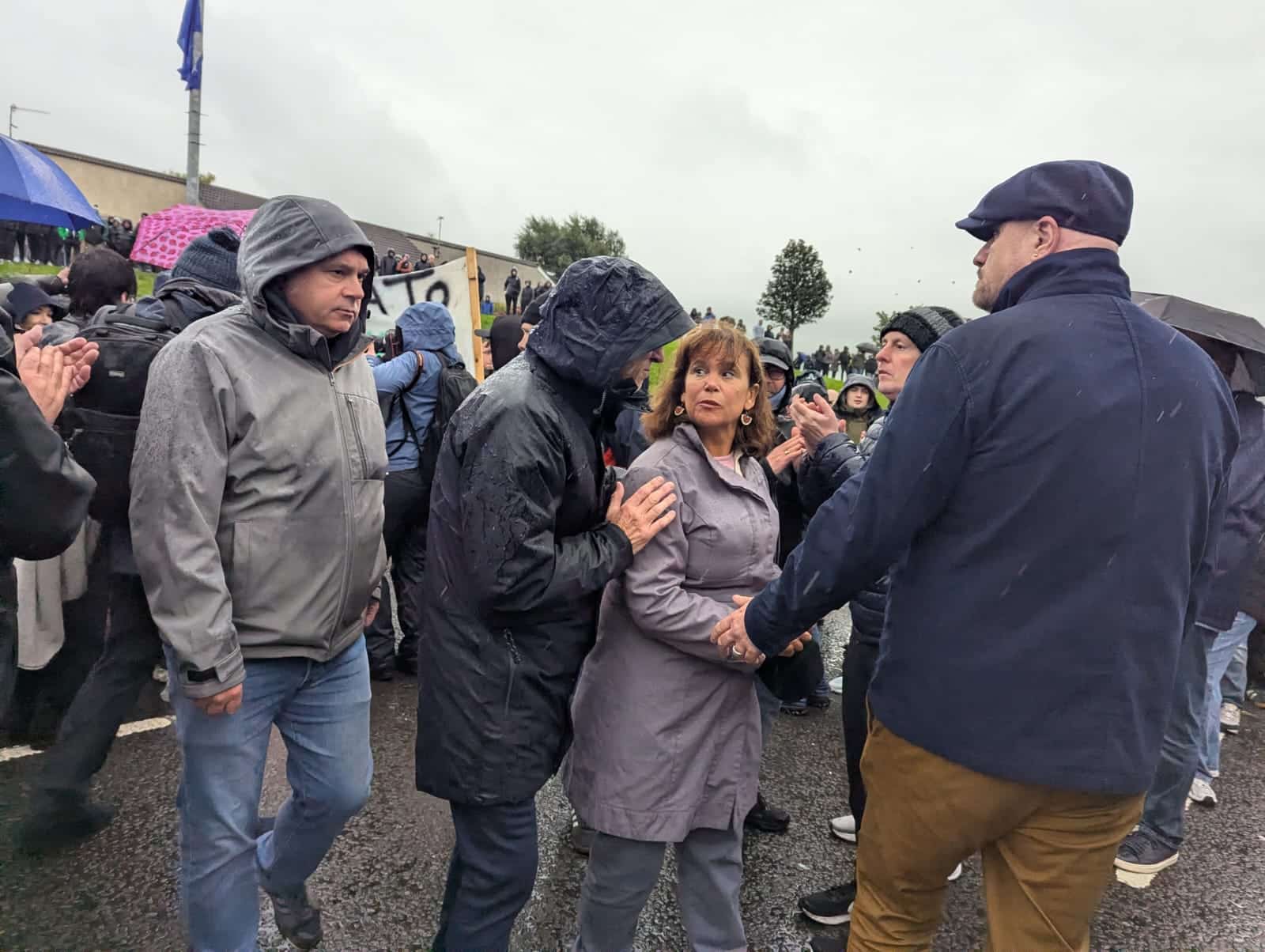
As of Sunday afternoon a large crowd remains on the Garvaghy Road, blocking the contested section where the Parades Commission had authorised a small, silent Orange Order parade for the first time in almost three decades.
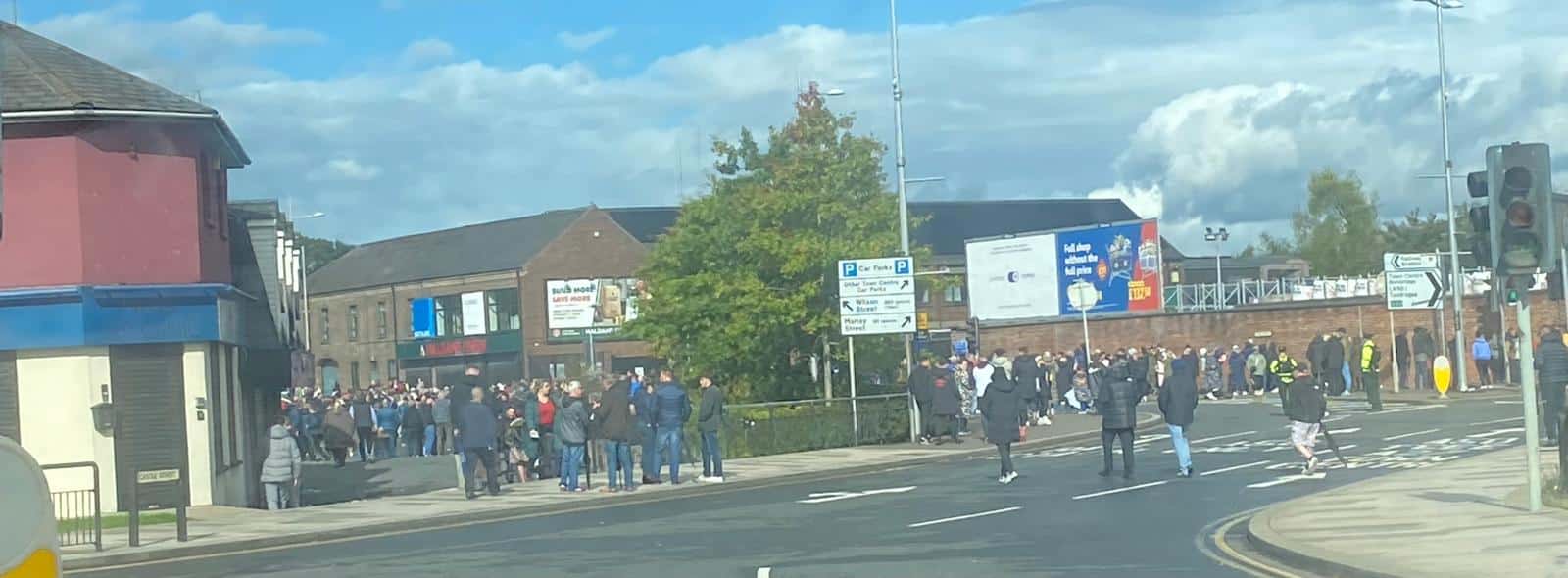
Numbers have steadily built over the course of the day, with people arriving from across the wider area to support local residents. Crowds, in support of the Orange Order are also building on the far side of Shillington’s Bridge in the town, as the await the parade. No crowds have gathered on Drumcree Hill.
A public address system has been set up and music played into the damp autumn air, with protesters singing along to Oasis’s “Don’t Look Back In Anger” and Christy Moore’s “Ride On”. Despite the political heat around the dispute, the atmosphere on the ground has been described as calm.
Residents’ representatives have said they are determined to stop the parade. Spokesperson for the local residents’ association, Breandán Mac Cionnaith, has insisted they will not negotiate with police over clearing the road.
The first minister, Michelle O’Neill and Sinn Féin president Mary Lou McDonald are among those who joined the protest line earlier in the day, prompting sharp criticism from unionist leaders who have branded the demonstration unlawful.
On Drumcree Hill, the 35 (30 members and five marshals) Portadown Orangemen selected to walk the Garvaghy Road – under a Parades Commission determination that limited the parade to 35 silent participants with no bands and tight time restrictions – have remained in place in torrential rain, waiting for word from the PSNI.
Speaking to media, DUP MP Carla Lockhart hailed what she described as “a seismic win within the courts”, claiming that “the law is on our side”.
“Obviously, we have had a seismic win within the courts. The law is on our side and you will have seen the 35 men. That’s what they’re afraid of – 35 men walking peacefully down a road with no band, silently, with a collarette,” he said.
She contrasted that with what he called “an absolute rabble down there with thousands chanting, and our first minister for all – or our self‑proclaimed first minister for all – leading the chants and standing unlawfully”.
“I stood in Scarva between the protesters and the parade to keep the peace. There’s a stark difference in what’s happening on the Garvaghy Road,” she added.
DUP leader Gavin Robinson told supporters that if the Orangemen have to wait longer, they will do so.
“If it takes another 28 hours, if it takes another 28 days, they will show the same steadfast determination and patience and a willingness to uphold the law that’s been there for the last 28 years,” he said.
Earlier he accused Michelle O’Neill and other Sinn Féin representatives of “breaching their pledge of office” by “participating in an unlawful protest” and “giving two fingers to the police, the courts and the rule of law”, calling for “unanimous condemnation” of their actions.
Taoiseach Micheál Martin has appealed for “calm on all sides” but made clear his unease with how the situation has developed.
Speaking to RTÉ, he described the Parades Commission’s original decision to allow the Orange Order onto the Garvaghy Road as “incomprehensible and wrong”.
“For 28 years, we didn’t have a parade there and most people anticipated that to remain the same,” he said.
He acknowledged that the courts had been “faced with the situation they were faced with” and had “taken their decision”, but urged all parties to “step back” to protect “the gains that have been made over the last 28 years”, which he described as “immeasurable”.
The Taoiseach said mediation was now key to protecting “the peace and harmony that has prevailed” in Northern Ireland in recent decades.
Sinn Féin has called on Northern Ireland Secretary Chris Bryant to use his powers to ban the parade altogether – something he can only do if requested by the PSNI Chief Constable on the grounds of a serious risk of public disorder.
So far there is no indication such a request has been made, and both the Secretary of State and police have stayed publicly silent on whether that remains a live option.
Analysis from security sources and commentators suggests the PSNI face an extraordinarily difficult set of choices if the stand‑off continues.
Veteran journalist Allison Morris has outlined some of the scenarios under discussion: riot police moving in in large numbers to clear the road – a move that would almost certainly risk unrest – a decision by the Orange Order to withdraw, which there is currently no sign of, or a revised security assessment which could see the Parades Commission’s determination withdrawn at the request of the Chief Constable and Secretary of State.
There has also been speculation that officers could attempt to slowly and incrementally push the protest back. But with elderly residents and senior politicians among those gathered – and cars deliberately parked across the carriageway – that would be slow, highly sensitive work and could easily inflame tensions.
Police commanders are understood to be acutely aware of the potential for trouble as darkness falls, both on the Garvaghy Road and on Drumcree Hill.