Leslie Busby was only a young and wet-behind-the-ears police constable when he last set foot in Poyntzpass.
But it was a chance encounter on a golf course – far back in time and beyond County Armagh – that led to his return this week.
It was at the invitation of Hugh Daly, honorary secretary of Poyntzpass and District Local History Society, that Leslie came back.
And he did so to recreate a photograph which captured a key moment in the village’s past.
“I met Leslie at a golf outing about 20 years ago and was chatting to him during the round,” explained Hugh, reminiscing with Armagh I. “It turned out he was a retired policeman.
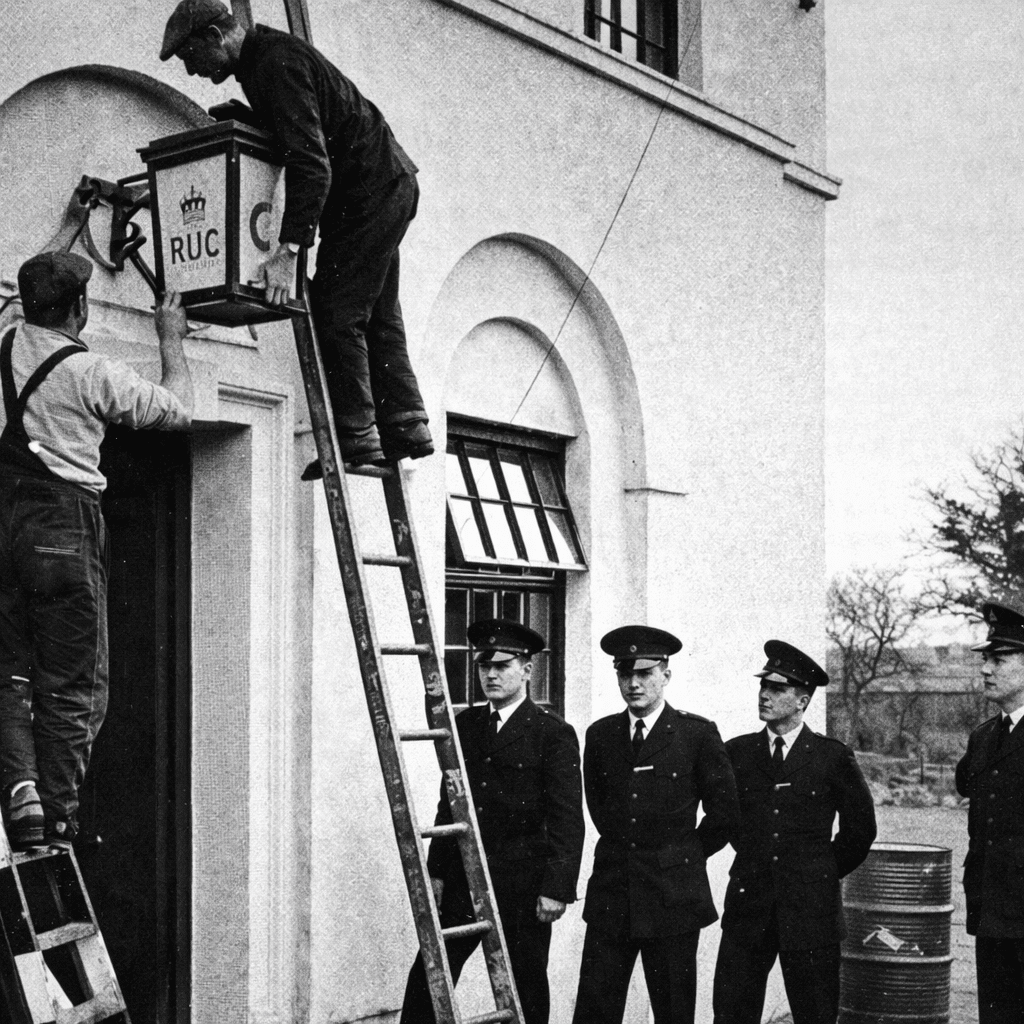
“Later on in the round I asked him where he was stationed and he said the very first station he was at was a wee place called Poyntzpass. I said, hang on, that’s where I’m from! I was then checking through some of the old records in the History Society and we had a photograph of the station being closed in 1967.
“I looked at the information on the photograph and there was that same policeman, Constable Leslie Busby, standing with a couple of others as they took the lamp down outside the station.
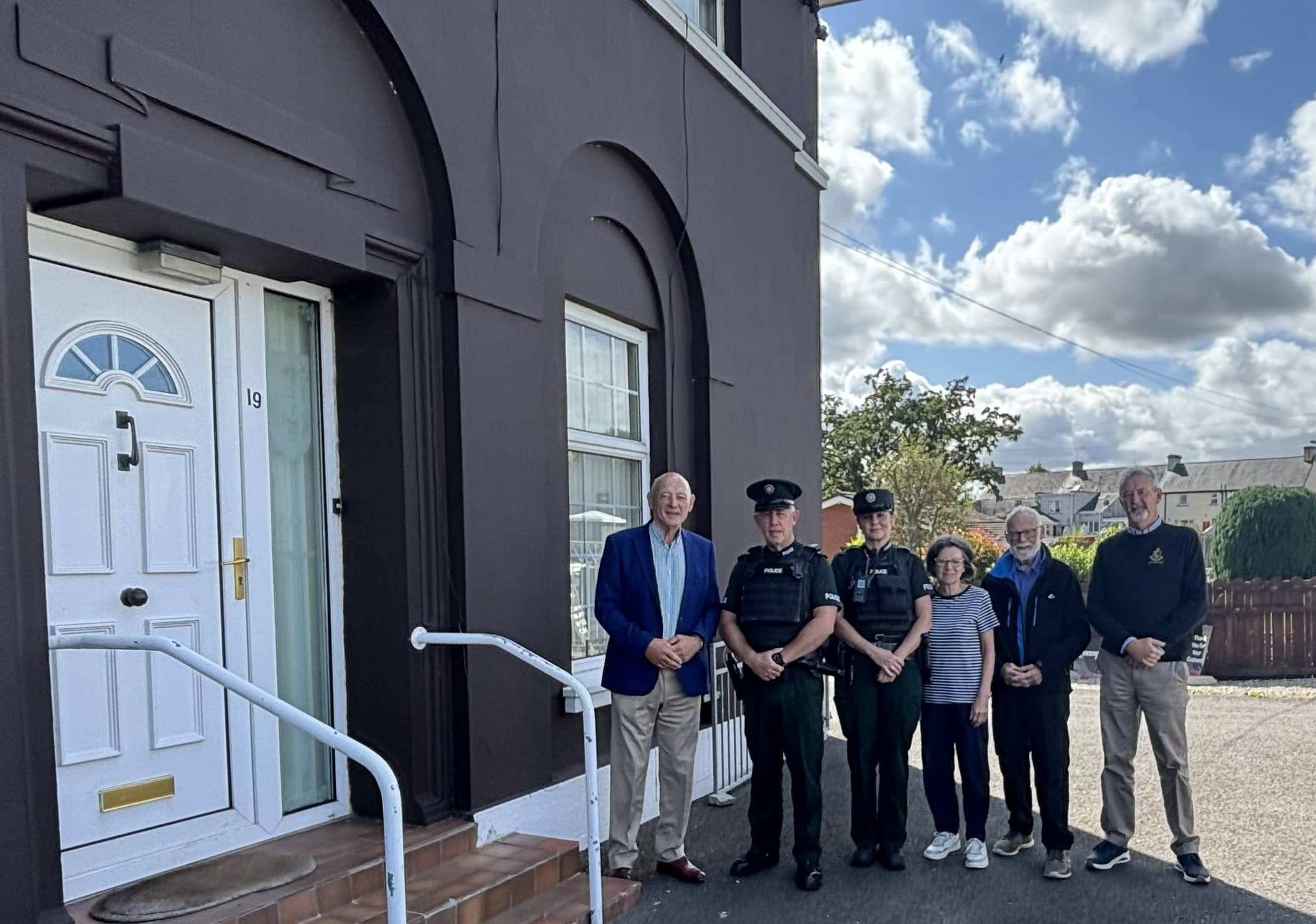
2026: Leslie Busby returned to recreate the picture at the scene of Poyntzpass police station. Included are PSNI Inspectors Kieran Quinn and Kelly Moffett, and Poyntzpass & District Local History Society members Helena Gamble, vice-chairman, Roy Copeland, past chairman, and honorary secretary, Hugh Daly.
“It took a while to track him down actually, but I found him on Facebook, and his daughter, and after a while finally got around to chatting to him. I suggested, would he come back some day and just replicate that photograph?
“Leslie said that whenever he joined the police force in ’67, he was stationed at Poyntzpass. It was his first deployment and then just weeks later he was told they’re closing the station down. So he didn’t get to be there for very long but he was there for that photograph anyway.”
Leslie actually grew up on a farm near Ballygawley, County Tyrone. As one of four siblings, he soon realised that work outside the family farm would be essential. When a schoolteacher suggested a career in policing, Leslie embraced the idea and in August 1966 he began his training in Enniskillen.
Upon completing his initial training, Leslie received his first posting: the small rural village of Poyntzpass — a place he had to locate on a map before setting off!
On arrival on February 1, 1967 he was welcomed by Sergeant D.K. Rodgers, who informed the young constable that the station was due to close in three weeks.
Despite the brevity of his stay, Leslie retained vivid memories of those early days.
He recalled removing sandbags from the station windows, remnants of precautions taken during the 1956–62 Troubles, and polishing the front doorsteps in preparation for visits from the local District Inspector.
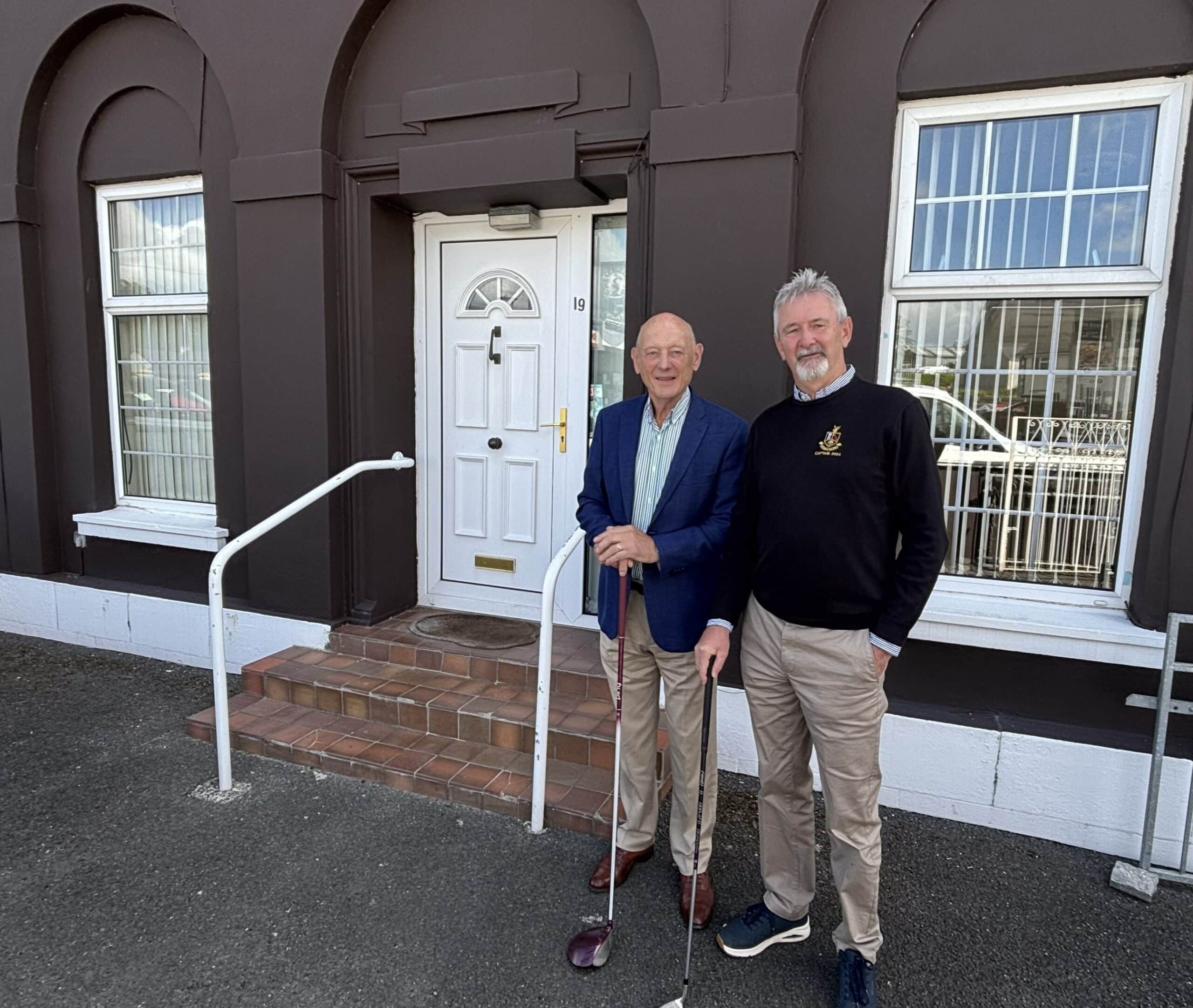
Leslie Busby returned to the site of the former police station in Poyntzpass, where he had been stationed when it closed it 1967, at the invitation of Hugh Daly, honorary secretary of Poyntzpass & District Local History Society.
After Poyntzpass, Leslie was deployed to Crossmaglen, where he served for three years.
Hugh himself now lives in Belfast, not far from Shandon Park Golf Club, where he and Leslie’s paths first crossed.
“It was a golf outing my work was sponsoring. I just happened to be partnered with this guy,” explained Hugh. “I thought it was quite humourous at the time, but then eventually, now I’m retired, I thought it would be a good idea to try and replicate that photograph.”
The police station is still standing in Poyntzpass but today enjoys residential use. It had been bought by the family of the current owners shortly after it closed back in the late 1960s.
“The station is the exact same layout as you’ll see in Loughbrickland and Rathfriland,” added Hugh. “It’s that sort of same country station that was built sometime in the early 20th Century.
“It may have closed because there was not enough money, maybe not enough crime, or it was more efficient to deal with it from the bigger stations like Newry and Banbridge. It was all sorts of economics and efficiencies.”
The newly-taken photograph, when paired with the earlier image, will now provide a nice little footnote to the long-gone station’s story.
And it is thanks to the wonderful work and effort put in by Hugh and History Society members that the proud past of Poyntzpass is able to live on.
For the Society provides endless opportunities to revisit and celebrate buildings, characters, occasions and anniversaries of note, and to do so in an enjoyable and informative fashion.

“We formed in 1971 and we have talks between September and April,” explained Hugh. “We have anywhere between 50 and 80 people coming to the talks and then in the summertime we have various outings or field trips. In fact, we have just had a field trip up to the Windmill Stump, which overlooks Poyntzpass. I’m in my 60s and that was the first time I was ever up at it.
“It’s all cross-community, a nice thing to do. We were very lucky with the weather and we’re currently trying to produce a video of it. We try to stay in contact with our diaspora through the website and Facebook and YouTube channel.”
Such talks, activities and social occasions, Hugh believes, are not just important but necessary, preserving the past for the future and affording an eye-opening glimpse and a tangible connection to times long gone.
“One of the things we do in our society is that we always try to get local people to talk about local subjects,” he added. “ We’re not shipping in professors in history, archaeologists or whatever. We’re trying to get local people to do it and you will always find there’s new subjects to talk about.
“One of the talks last year was by a member called Rob Morrow, who talked about Poyntzpass being on the ‘fault line’ between County Down, which was the early Plantation, and County Armagh, which was the later Plantation. He talked about the mix of accents and how you can tell sometimes where people are from. The County Down ones talk slightly different than the County Armagh ones and the border runs right through the village. It’s things like that that just bring it to the surface and it’s just fascinating.”
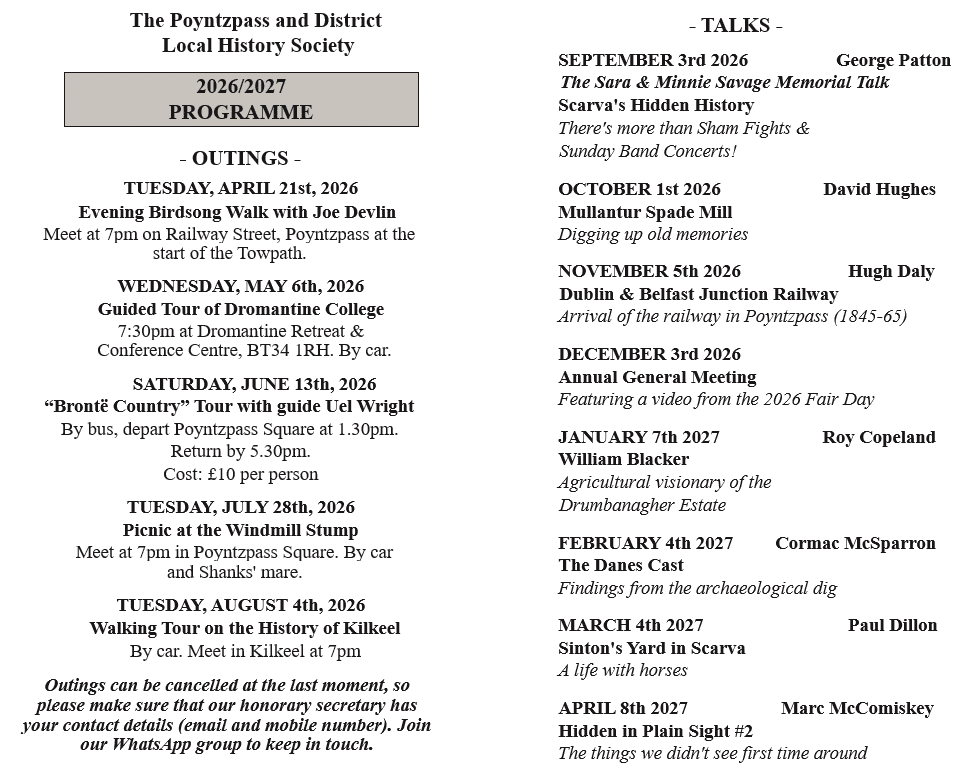
The busy Society programme for the current 2026/27 year.