The former Parochial House in Tandragee could be demolished under fresh plans drawn up for the town centre site.
Outline planning approval is being sought at this stage, with an application lodged with Armagh City, Banbridge and Craigavon Borough Council.
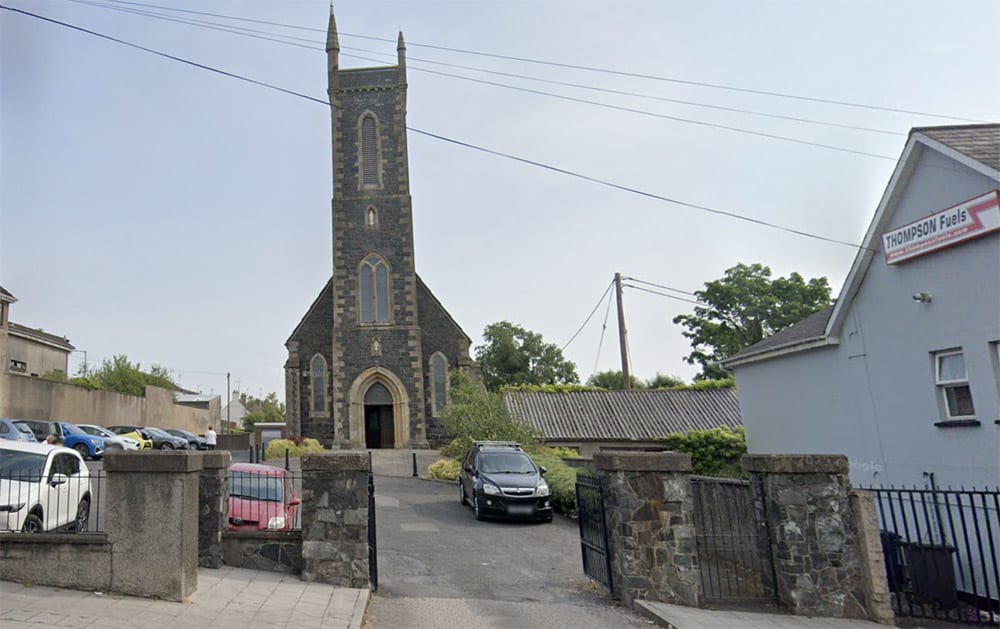
The Parochial House sits to the rear of the Church of St James the Apostle, set back from the broad Main Street.
In all, it is hoped to demolish several buildings – the Parochial House, a garage and outbuildings – as well as an adjacent wall and gate on the north-east boundary.
If approved, the intention is to construct a more up-to-date replacement.
The application has been made in the name of Fr Michael Woods, with an address given at the Parochial House in neighbouring Poyntzpass.
A design and access statement explains: “This is the former Parochial House which is currently vacant. Given its age, it is
proposed to replace it with a modern design.”
The proposed site is situated adjacent to the church; it currently has two accesses, one through the church car park, which would be closed off, and the other to the rear, off Cornmarket Street, which would be retained.
The overall site stretches to in excess of 34,000 sq ft.
And while the church itself is a listed building, having been built in the 1800s and consecrated in May 1853, the Parochial House is not.
It was constructed in the 1960s and, if approval is given, the hope is to demolish it to make way for a “potential family home” with three or four bedrooms. While this is an outline application, the expectation at this stage is that the replacement could be either a one or two-storey home, or a cottage style house.
The design statement reveals: “The replacement will include demolition of the existing buildings; reusing the brownfield site will be positive.
“It is also our client’s intention, within budget limits, to try and incorporate, where possible, environmental measures. Sustainability will be a key factor in any future design through sensitive siting, material choice and building specification.”
A biodiversity checklist has been completed, with ecologist Judy Meharg, a director with Fieldfare Ecology Ltd, having visited the site last summer.
She could find no evidence of either bird or bat activity which would prevent the works going ahead.
Ms Meharg reported: “The house and garage were inspected inside and outside for their suitability for nesting birds or as a bat roost. Signs of bat use in the buildings, such as bat droppings or odours, was also checked for. Nothing was found.
“The house had soffits which were plastic and tightly fitting. All vents had grills. The garage had a louved window and door but there were no signs of bats or birds using the building. The concrete block built outhouse had a tin roof over a solid timber ceiling and grills on the only opening. It was not suitable for bats or accessible for birds.”
While dense ivy growing over the outhouse “could provide a bird nesting habitat”, upon thorough inspection of the buildings to be demolished, she confirmed “they are not currently used by roosting bats or nesting birds nor are they suitable for them”.
With that proved, it was considered further ecological surveys were not required.
However, Ms Meharg added: “I would recommend that the buildings are demolished outside the bird nesting season of 1st March to 31st August, so as to reduce the disturbance to birds that may be nesting in the ivy on the outhouse or nearby shrubbery.”
Neighbours to the proposed site and works are in the process of being notified and the application will now be advertised shortly.