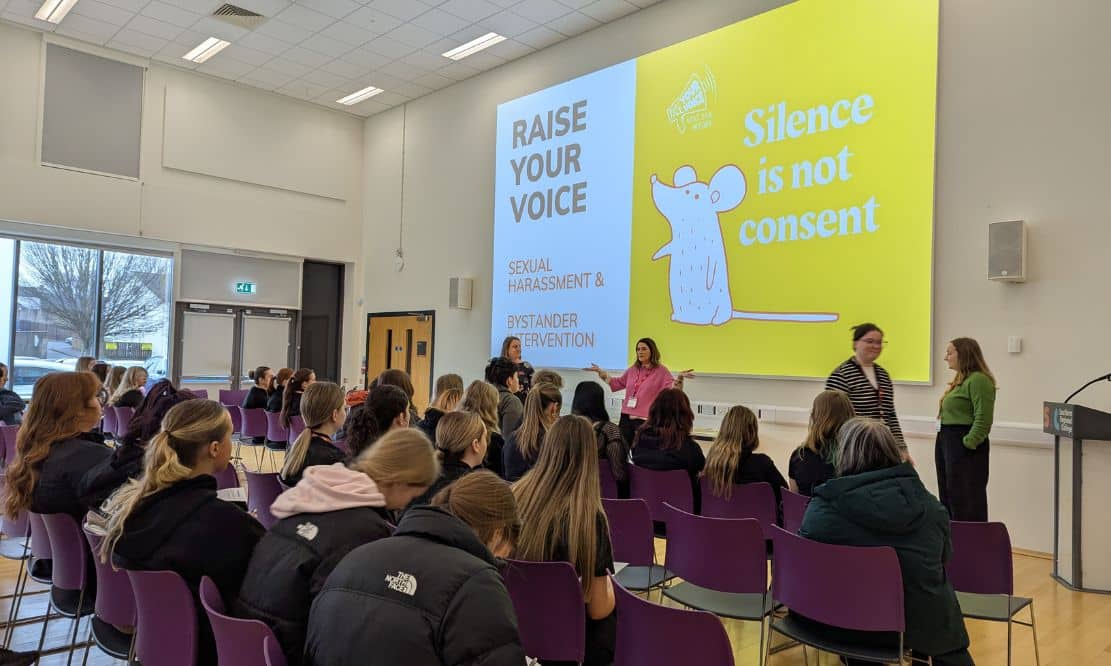
As a society we should all do our part to minimise violence against women and girls. This was the core message delivered to SRC students attending a multi-agency sexual harassment training programme on February 19.
The training was delivered in the Armagh campus building – on Lonsdale Road – by Raise Your Voice, members of the PCSP and Armagh Neighbourhood Policing team.
Raise Your Voice is a project led by Women’s Resource & Development Agency (WRDA) with partnership support from Reclaim the Agenda, NI Rural Women’s Network, and Women’s Support Network.
Their aim is to create true cultural change in order to tackle and remove the root causes of behaviours that lead to sexual harassment and violence.
Armagh I were also invited to attend the training programme, which began on site just after 10am.
Attending on behalf of the PCSP, Annette Blaney and Lynette Cooke introduced Sarah Stack and Evie Gilbert, from Raise Your Voice, to a room of approximately 60 students across various disciplines, from hairdressing and barbering to performing arts.
Speaking to the room, Sarah explained that sexual harassment had been “normalised in society” but they had means of “tackling” these attitudes.
Approximately 78% of sexual crimes are perpetrated against women and girls, she explained. This, she continued, demonstrates the need for a female specific focus.
The students watched a short video clip which was produced by the Irish Department of Justice which showed various scenarios where sexual harassment could take place.
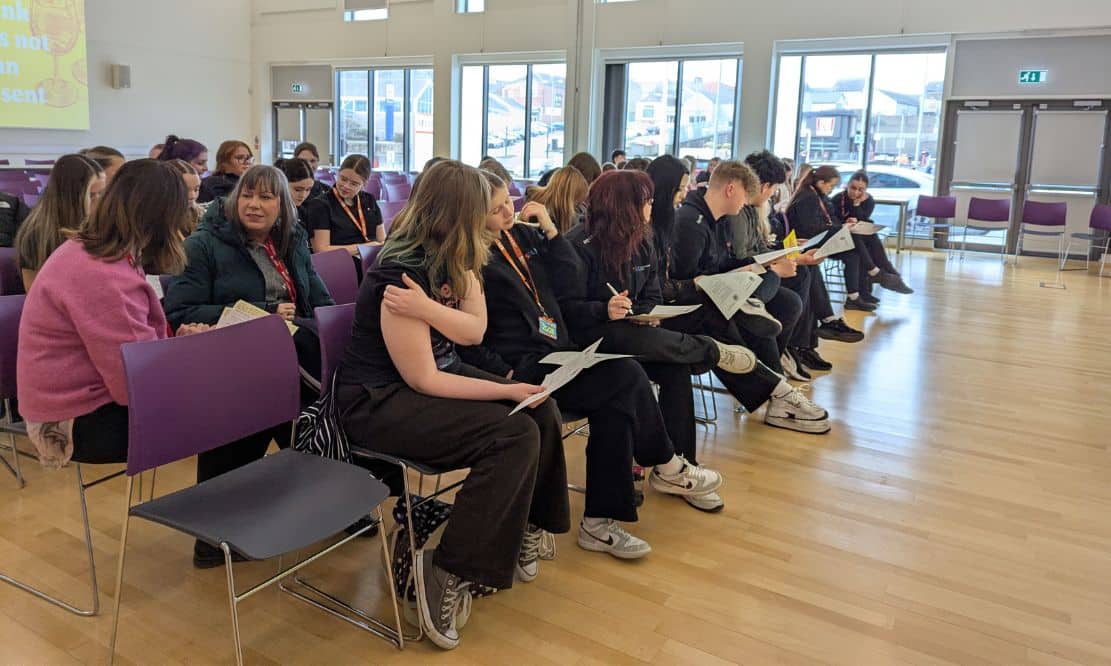
Students completing a short workshop on how they would intervene as Active Bystanders
When asked for their feedback, the students were keen to share their thoughts. They pointed out where consent seemed to be lacking, noticed the environments where the harassment took place and discussed their understanding of the body language, verbalised objections and facial expressions witnessed.
Sarah then asked the room what they thought the impact of sexual harassment may be for the people in the video.
Very astutely, the students proffered “trauma”, “economic impact”, “self esteem” and “confidence” as the impacts for victims.
They were shown a ‘Pyramid of Sexual Violence’ which demonstrates how a tolerance of behaviours at the bottom of the pyramid can lead to an escalation and support behaviours at the top.
At the bottom it shows traits like cat calling, body shaming, objectification and a “boys will be boys” attitude slowly escalating to other behaviours, including rape “jokes”, excessive attention, unwanted touch, up-skirting/down-blousing, stalking, deepfakes, doxing, spiking, sexual coercion, molestation, rape, forced marriage, murder and family annihilation.
Sarah and Evie then moved on to discuss the important role of the active bystander in helping to combat instances of sexual harassment. Both said it is important for all of us to “intervene in a safe way when we see something happen”.
Said Evie: “Bystander intervention is what it says it is. We are standing by and maybe not directly involved… but instead of letting it evolve, we step in and intervene.”
Explaining their ‘5D’ strategy for intervention, Sarah and Evie outlined:
- Distract – create a distraction, change the subject, change the focus
- Delegate – ask for help, whether it be from an individual, organisation or body
- Document – record evidence including time, date and location
- Delay – Find time for the victim or perpetrator
- Direct – Speak directly against the action to deescalate the situation
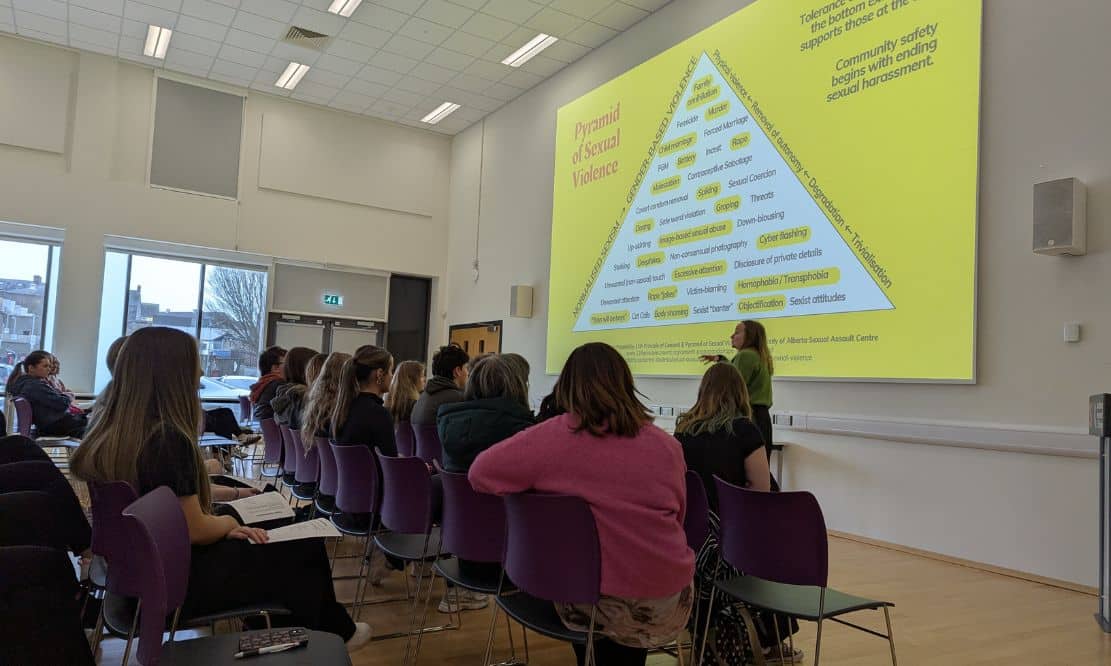
The Pyramid of Sexual Violence
Students were provided with a “toolkit” which outlined the ‘5Ds’ and discussed scenarios where these measures could be implemented and asked what options they would choose.
They were reminded at all times to remain safe and be kind.
Constable Matthews, of Armagh Neighbourhood Policing team, then spoke to students, stressing the importance of ‘documentation’ and evidence gathering as her “favourite” of the 5Ds.
Said Constable Matthews: “I loved the pyramid [an infographic of normalised sexism and sexual violence behaviours]… that’s something we can do as a society to chip away at those norms and tackle misogyny and also hate crime, when it comes to racism.
“It’s about tackling those behaviours by being an active bystander. This training has given you some of those practical skills, to know what you can do. You’re not coming away from a situation knowing it wasn’t right and not having done anything.
“It should give you a feeling of empowerment and know what you can do and what steps you can take. It just takes that one person to step up to make a difference.”
Several contacts for support networks were provided to all attendees.
If you or anyone you know has been impacted by the topics mentioned in this article you can access support and advice from the following organisations:
- Informing Choices NI – informingchoicesni.org
- NSPCC – 0808 800 5000
- Assist NI – assistni.org.uk
- Nexus NI – neusni.org
- Women’s Aid NI – womensaid.org
- Belfast Trans Resource Centre – belfasttrans.org.uk
- Rainbow Project – rainbow-project.org
- Lifeline – 0808 808 8000
- PIPS Suicide Prevention – pipscharity.com
- National Stalking Helpline – 0808 802 0300
- PSNI – 999 or 101 psni.police.uk/contact-us
- Victim Support NI – victimsupportni.com