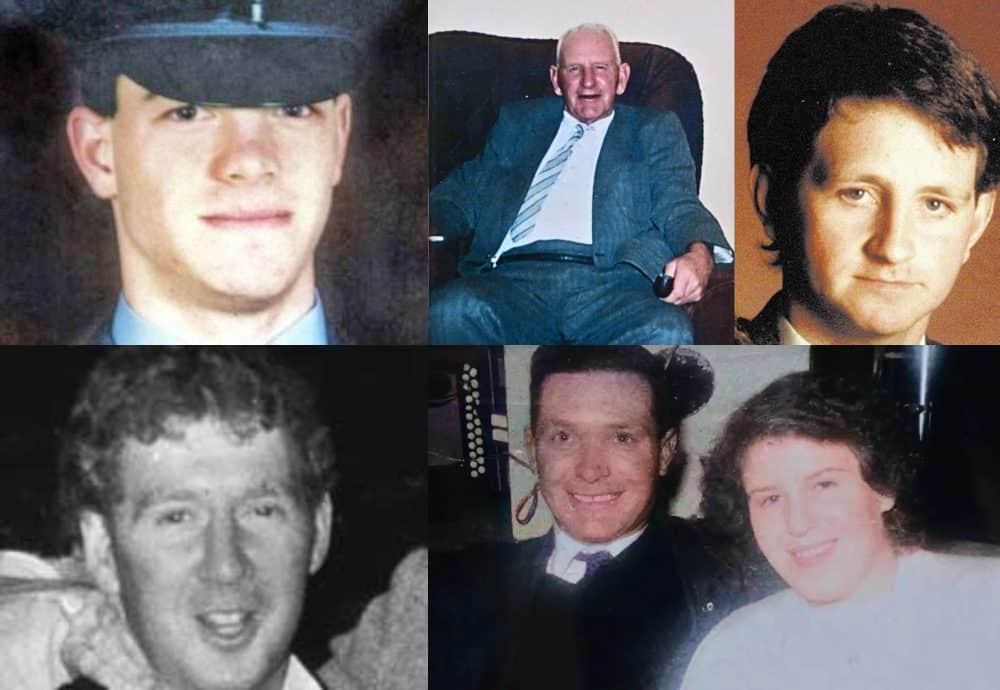
Four families fighting for answers into the brutal murders of six loved ones during The Troubles have been told by a High Court judge they must await the outcome of a looming Supreme Court decision on the murder of a Dungannon man that could rewrite the law on legacy killings.
The campaigning families connected to victims of The Troubles in the Moy and Lurgan have battled long and hard in challenging decisions about how police investigations into the killings were handled – including concerns over alleged state collusion.
The legal action was brought by four applicants — Bernadette McKearney, Anthony Fox, Linda Hewitt and Raymond McCord — who are connected to victims of several killings in the Co Armagh and Tyrone areas in 1992 and in Antrim in 1997.
The case relates to the killings of Kevin McKearney and his uncle, John McKearney; husband and wife Charles and Teresa Fox in Moy; Samuel (Sam) Marshall in Lurgan; and Raymond McCord Jr in Newtownabbey.
On January 3, 1992 gunmen entered a family-owned butcher shop in Moy where Kevin and John McKearney were working. They shot and killed both.
Later that same year, the widow of Kevin McKearney – Bernadette McKearney (nee Fox) – together with her sister discovered the bodies of her parents, Charles and Teresa in their home nearby. They too had been shot dead.
The killings shocked the local communities across parts of south Tyrone and north Armagh, where both the families were well known.
The following year, Laurence Maguire was arrested in possession of a loaded VZ58 rifle which was used in the murders of Charles and Teresa Fox.
He admitted to being the getaway driver in the Fox murders and to purchasing the car which was used in the McKearney murder but denied involvement or knowledge of the murder itself.
Maguire was convicted and sentenced to life imprisonment for a total of five murders including Charles and Teresa Fox but not of any offence related to the McKearney murders.
A subsequent Historical Enquiries Team (HET) report in relation to the McKearney murders identified eight separate shortcomings in the original RUC investigation and could not allay family concerns about collusion on the part of security forces.
These included allegations made by Maguire that the UVF was regularly provided with security force photographs of individuals for the purposes of targeting.
In the years that followed the murders, no inquest was ever conducted.
Linda Hewitt also brings her case as the sister of Samuel Marshall, who was shot and killed by loyalist paramilitaries in Lurgan on March 7, 1990.
Samuel was killed while walking home from Lurgan RUC station with two co-accused, having just signed bail on charges of possession of ammunition.
Concerns about collusion in the murder have been held by the family from the outset. It occurred in a public street, in close proximity to the police station.
In the month beforehand, police appear to have received information naming six individuals who were targeted for attack, including Sam Marshall. However, he was not warned about the threat until a number of weeks later.
Raymond McCord brings his case on behalf of his son, Raymond McCord Jr, whose body was found in Ballyduff Quarry on November 9, 1997. He had been beaten to death.
An RUC investigation into the death was carried out but no perpetrator was ever identified.
The Police Ombudsman later carried out an “extremely extensive investigation” (Operation Ballast) into allegations of collusion between the RUC and the UVF in relation to the murder. It was later broadened to include the handling by the RUC of informants from the 1990s onwards, including the involvement of informants in the murders of seven other persons.
The report identified investigative failures by the RUC. A coroner was subsequently appointed to carry out an inquest but as the disclosure process was so prolonged the inquest did not proceed and was formally closed in September 2024.
In recent years, the cases have been examined through legacy inquests designed to review unresolved deaths from The Troubles.
The families argue that there were failures in the investigation and review of the killings, that decisions taken by public authorities were unlawful or procedurally unfair and that to this day, they have not received full answers about what happened.
On Monday February 2, 2026, the four applications for leave to apply for judicial review were all heard together before the High Court.
During the leave stage of judicial review, a judge decides whether the case is strong enough to proceed to a full hearing.
While the facts of each case are different, all four applicants seek mandatory orders requiring the Secretary of State to establish public inquiries into the circumstances of the death of their family members.
In each case, the death was the subject of an inquest which involved allegations of state involvement or wrongdoing and in which national security sensitive materials were produced to the coroner by one or more of the security forces.
In three cases (Fox, McKearney and Hewitt), the inquest was closed by the coroner on the grounds that the extent of information, which was subject to public interest immunity, prevented the completion of the inquest in accordance with its agreed scope.
In the fourth case (McCord) a very large volume of national security sensitive information was produced to the coroner.
However, before ruling on public interest immunity, the inquest was closed by the coroner in accordance with the statutory requirements of section 16A of the Coroners (NI) Act 1959, which requires that an inquest be closed if evidence has not concluded.
The Secretary of State accepts that the cases could proceed under the current law in Northern Ireland.
However, he says the law might change depending on the outcome of a case currently before the Supreme Court (Re Dillon).
Re Dillon is a separate major legal challenge to the UK government’s law dealing with unresolved crimes from The Troubles.
The case was brought by several victims’ families, including Martina Dillon, whose husband was murdered by loyalists in 1997 in Dungannon.
They challenged parts of the Northern Ireland Troubles (Legacy and Reconciliation) Act 2023, which changed how Troubles-related deaths and crimes would be investigated.
The case was previously submitted to the court tied with Re Brown, however, the two were separated and, as such, The Secretary of State now asserts it is prudent to wait for the findings before proceeding.
Because of this, he has asked the court to pause or delay these applications until the Supreme Court makes its decision.
The case is part of a broader legal and political debate about how the past should be investigated.
Many families across Northern Ireland are still pursuing legal action in an effort to uncover information about killings during the Troubles, particularly where they believe investigations were incomplete.
Legal representation for Mr McCord, McIvor Farrell explains in the application for leave to apply for judicial review: “The unspeakable trauma which must have been endured by the Fox, McKearney, Marshall and McCord families as a result of all of these heinous crimes is difficult to conceive for anyone who has not experienced such tragedy.
“The pain which each of those families have endured can only have been exacerbated by the emergence over time of allegations of wrongdoing on the part of the state in each of these cases.
“The court is deeply conscious of the sensitive position of all of the families and of the importance of progress in the investigations in order to understand the facts of what occurred and, if possible, to ensure accountability for any perpetrators.”
Having considered all submissions and legal issues, the judge concluded that the appropriate course of action is to adjourn the leave applications in all four cases until after the judgment of the Supreme Court is available in Re Dillon.
He said: “At that point in time, I will hear further submissions from all parties, informed by the content of that decision and determine how these proceedings should be progressed. I consider that this outcome is proportionate in all of the circumstances of all four cases. My reasons for reaching this conclusion are set out below.”
Once the decision of the Supreme Court in Re Dillon is available, the parties will be informed of a date for further review and any case management directions.