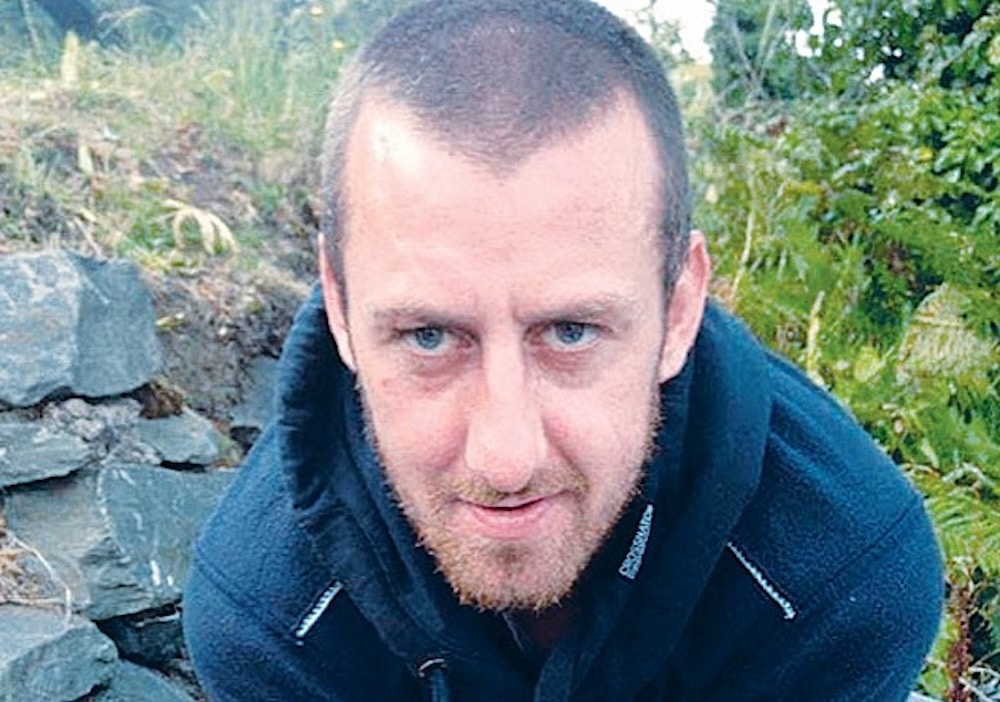
A Banbridge man who suffered a stroke and passed away in hospital after earlier being arrested and placed in limb restraints by police died of “natural causes”, a Coroner has ruled.
While Coroner Marie Dougan highlighted “failings” of the police in the hours that followed Jamie Wilson’s arrest and time in custody, these did not, she found, contribute to his death.
Mr Wilson died in the Intensive Care Unit of Craigavon Area Hospital on May 7, 2018.
An inquest – described as “complex” by Ms Dougan – was held over six days in March last year to determine the 33-year-old’s cause of death.
Ms Dougan detailed how, in the days prior to his death, he had been “involved in two interactions involving physical restraint by PSNI officers”.
Mr Wilson’s death was investigated by the Police Ombudsman and a file was forwarded to the Director of Public Prosecutions
However, in 2022, the Public Prosecution Service directed “there would be no criminal prosecution of any PSNI officers in relation to the death of the deceased”.
During the course of the hearing at Banbridge Courthouse last year, the inquest heard oral evidence from 15 witnesses, while a further 23 written statements, along with a substantial volume of medical notes and other relevant materials, including CCTV footage, were admitted into evidence.
Detailing her findings, Ms Dougan took close to three hours today (Thursday) to read aloud, in full, her 67-page report, broken down into seven sections, having given “full, careful and conscientious consideration to all of the evidence presented”.
And as she began, the Coroner said: “It is my sincere hope that my findings will serve to settle any pre-existing rumours and suspicion by providing an evidence-based account of the circumstances in which the deceased died.”
In the early hours of April 30, 2018, police attended following an alleged assault by Mr Wilson on his girlfriend, after they had been drinking together in Banbridge.
Mr Wilson was arrested and conveyed to Banbridge Custody Suite. During transit, he was reported to have “repeatedly struck his head against the window” of the vehicle and “became aggressive, requiring restraint by police officers”.
On arrival at Banbridge Custody Suite, further restraint was required, including the use of handcuffs and leg restraints before he was placed in a cell.
Later that morning, Mr Wilson was observed “lying on the floor of the cell, exhibiting unusual movements and incontinence”.
A forensic medical officer attended and noted Mr Wilson was “breathing well and easily roused”, and “considered him fit for detention”, while arranging a further review.
The deceased subsequently complained of “headache and sensitivity to light” and “appeared improved in further assessment”.
He was later interviewed, charged and released on bail.
On the evening of May 1, 2018, Mr Wilson was found at home by his sister, Zoe Wilson-Brown, and a neighbour, when he was “confused, with right-sided weakness and vomiting”.
He was taken by ambulance to Craigavon Area Hospital, and later transferred to the Royal Victoria Hospital for further imaging which confirmed a “significant stroke” and that “active intervention was not considered appropriate”.
Mr Wilson was later returned to Craigavon Area Hospital, where his condition deteriorated, following confirmation of “brain stem death”, and he died on May 7, 2018.
The deceased had been arrested at his home after an alleged assault on his girlfriend, with whom he had been in a relationship since August 2017.
She said Mr Wilson had told her recently he had headaches and problems with his vision. He used to “sit and grab his chest when it became tight” and he “also had pains in his arms”. This occurred “a few times, but he did not attend the doctor”.
A police witness told how he was part of a three-person response crew which attended an address in Banbridge after a radio transmission to respond to “a report of an unresponsive female with a suspected head injury”.
A short time after they arrived, a second two-man crew arrived. Handcuffs were placed on Mr Wilson, who had been arrested on suspicion of assault, occasioning actual bodily harm, and making threats to kill.
Mr Wilson “cooperated” and got into the police car for transit to Banbridge Custody Suite. Within the “first minute or so” of the journey, the deceased began to “make strange noises” and “put his head down towards his knees”. He then started “hitting his head off the window of the police vehicle”.
With the “change in behaviour”, the police vehicle stopped, and one of the officers “put two hands on the deceased to try and bring him up back into the seat”.
Multiple police witnesses gave evidence. One officer “kicked towards” the deceased, who had tried to grip his arm, while he was still sitting in the car, but this was not recorded in statement or notebook card giving evidence.
Events “calmed down”, and the deceased was heard saying, ‘I just wanted to see what you have and you have nothing’. One of the officers had informed another that Mr Wilson had “elbowed him in the chest” and he was further arrested for the assault of a police officer.
For the rest of the journey, the deceased “remained calm”.
On arrival at the custody suite, the arresting officer spoke to the custody sergeant. CCTV footage of these events was played throughout the inquest and, according to the custody record, the time of arrival was 2.05am.
The officer accepted he did not inform the custody sergeant about the deceased banging his head against the car window, as he “did not deem it to be that important”.
The deceased was led from the police vehicle to the custody hatch and the handcuffs were removed.
The inquest was told that Mr Wilson subsequently was restrained by five police officers and a civilian detention officer after he went from being “very calm to very aggressive”, in the words of one police witness.
One police witness said that once the deceased heard the offence of assaulting a police officer, he “became extremely aggressive and said something along the lines of, ‘If I’m going to be done for assaulting police I might as well do what I’m getting charged for’”, and ”held out his arms in front of him in a fighting stance”.
The custody sergeant had taken the lead and was “very calm, professional, and directed how the restraint was going to take place”.
Two sets of handcuffs were placed on the deceased linked together, as well as leg restraints around his knees and around his calves, with Mr Wilson “lying prone on the corridor and then lifted in that position and carried” to a cell.
One of the officers told him that once he calmed down the restraints would be taken off and he “seemed to calm down quite quickly”.
One of the officers spoke of having “no concerns” about the length of time the deceased was in the corridor in the prone position, as “there was no change in his breathing and he was continuing to communicate”.
Mr Wilson was kept under “close observations”, the inquest heard, but later medical attention was sought when he appeared to have a form of seizure.
During her summation, Ms Dougan said her findings were made on the “civil standard of proof, namely the balance of probabilities”.
She found that Mr Wilson was “intoxicated at the time of his arrest, having consumed alcohol and drugs”, and that his “behaviour became increasingly unpredictable during transport to custody”.
While “initially cooperative”, he “became aggressive in the rear of the police vehicle” and gripped one officer’s forearm “with significant force, requiring intervention”.
The Coroner said she was “satisfied” that the officer “applied pressure points and strikes in an attempt to release his arm and to prevent harm”.
Ms Dougan further found the use of force in the police vehicle was “a reasonable and proportionate response to the threat and risk posed by the deceased”.
But she said a “kick towards the deceased’s hands was not a recognised or trained technique and should not have been used”.
She noted the deceased struck his head against the vehicle window during transport and this raised the possibility of a head injury and was “relevant information”.
“It should have been communicated on arrival at the custody suite in Banbridge Police Station,” said Ms Dougan. “Had this information been passed to the custody sergeant during the booking process, it is likely that the FMO would have been informed in due course.”
However, Ms Dougan found that “none of the above matters caused or contributed to the death, nor did they have any bearing on the overall outcome”.
The Coroner considered that the custody sergeant had not been “adequately informed of the events during transport, including the nature and extent of the force used by officers”.
She added: “I am satisfied that this information would have been relevant to the assessment of risk and welfare, particularly given the deceased’s intoxicated state. I find that the failure to communicate this information represents a departure from best practice. However, I did not find that this failure had any material impact on the eventual outcome.”
At the custody suite, Ms Dougan found Mr Wilson “became aggressive and displayed an unacceptable level of violence”, and that the “initial use of force and restraint by police officers was justified in order to prevent harm”.
But she said the use of a “headlock” by one officer was “not a recognised or trained technique and should not have been used”.
“I find that the deceased was restrained by multiple officers, placed in a prone position, handcuffed and fitted with leg restraints due to the level of resistance offered,” said Ms Dougan. “ I am satisfied that the initial restraint was necessary in the circumstances.
“I find, however, that the deceased remained restrained in the prone position in the corridor for longer than was necessary once he had been brought under control.
“I am satisfied that he should have been relocated to a cell more promptly. I find that restraints were removed incrementally over a period of time, with handcuffs remaining in place until approximately 4.26am. But it is acceptable in principle, and often good practice, to reduce the level of restraint incrementally. I find that the deceased was restrained for longer than was appropriate in all the circumstances after he had calmed down.
“I also find that the deceased remained in the prone position in the cell for longer than was appropriate. I accept that he was observed throughout, with communicating, and that no signs of respiratory distress were identified. I find that, although aspects of the restraint fell below best practice, particularly in relation to duration and positioning, they did not cause or contribute to the deceased’s death.”
She noted that the deceased “exhibited abnormal movements, whilst on the bed in the cell, predominantly under a blanket, and that these movements included involuntary activity consistent with seizure activity”.
“I accept that this episode was not directly observed either in person or on CCTV by custody staff,” said Ms Dougan.
The Coroner said she had considered “differing expert opinions” in relation to the “episode which occurred in the cell”, and accepted that the “deceased suffered a generalised seizure at that time” rather than one associated with “evolving stroke”.
Ms Dougan added: “I accept the medical evidence that there is no recognised causal link between transient ischaemic attacks and seizures. I am satisfied that the seizure was most likely attributable to alcohol-related factors, including chronic alcohol use, and possible withdrawal and dehydration.
“I find that this seizure was a separate and unrelated medical event and was not caused by nor an earlier and early manifestation of the stroke, which occurred more than 24 hours later.”
She was “not satisfied that the episode in the cell was causally connected with the stroke” and that these were “separate events arising in the context of shared underlying risk factors”.
The Coroner said Mr Wilson’s collapse off the bed, abnormal movements and incontinence, taken together, indicated a “potentially serious neurological event”. There was “sufficient information to prompt an urgent hospital assessment”, and while a police sergeant requested a medical review, a forensic medical officer “should have erred on the side of caution”.
The Coroner found that a “full and accurate account of the deceased’s presentation and condition should have been provided directly” to an attending doctor which might have “prompted a different clinical course”.
But Ms Dougan said that had the deceased been taken to hospital shortly after the seizure, a CT head scan would “likely have been normal at that stage” and would not, “on the balance of probabilities, have altered the eventual outcome”.
She was therefore “not satisfied that the failure to seek earlier hospital assessment caused or contributed to the death”.
Ms Dougan said Mr Wilson “subsequently improved sufficiently to be interviewed and released from custody”.
On May 1, 2018, the deceased’s condition deteriorated as evidenced by “incoherent communication and subsequent observations by family and friends”.
Mr Wilson’s sister and neighbour “acted appropriately and did what they could in response to the deceased’s condition”.
Meanwhile, the care and treatment at both Craigavon Area Hospital and Royal Victoria Hospital were “timely and appropriate”, and the Coroner was satisfied that “earlier intervention would not have altered the outcome”.
“I find, as agreed by the pathology and neurological experts, that any trauma before, during or after police custody did not cause or contribute to the death,” said Ms Dougan. “I find that the restraint of the deceased did not cause or contribute to his death. I am not satisfied that any of the identified failings, whether individually or cumulatively, caused or contributed to the death.”
The Coroner accepted that the timing of the stroke was “likely several hours prior to imaging but unlikely to have been as early as 24 hours”.
Ms Dougan found that the stroke was caused in the context of “chronic alcohol and drug issues, dehydration and associated risk factors”, adding: “I therefore find that the deceased died from natural causes.”
Offering her condolences to Mr Wilson’s family, the Coroner spoke of their “profound loss” and commended them for their “dignity and composure”.
“The deceased was described by those who knew him as a loving and loyal person, devoted to his family,” she added. “He was someone who valued time spent with those close to him, whether at family gatherings or in everyday moments. He was a much loved father, son, brother and friend, and had been seeking to improve his circumstances, having secured employment shortly before his death.
“His life, though not without its challenges, was centred on family friendships and simple pleasures. His death at a young age represents a significant and enduring loss to all who knew him.”