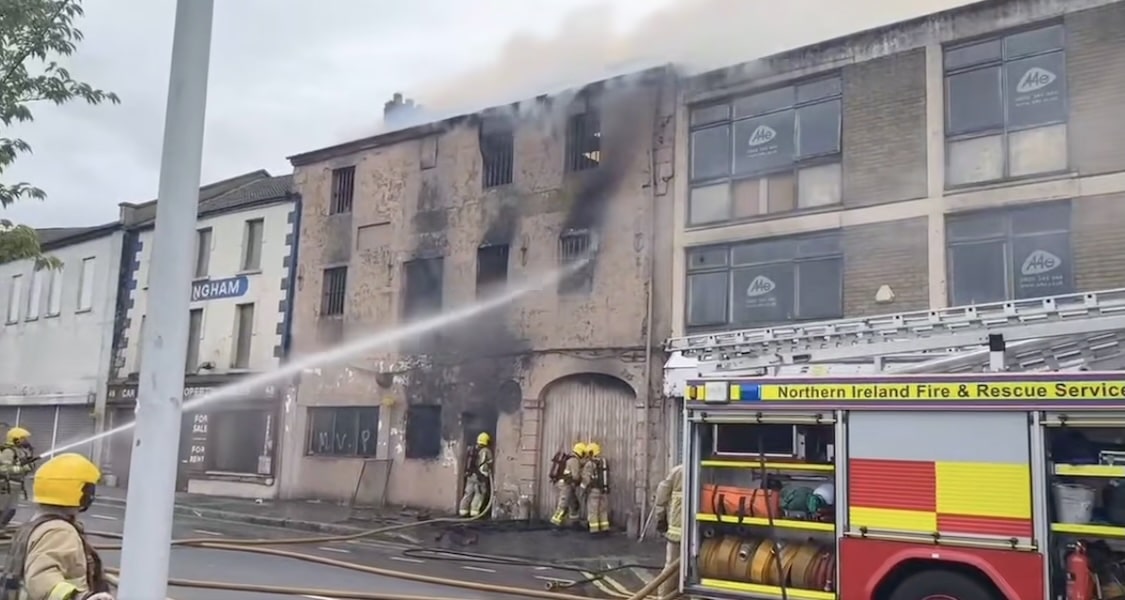
An historic Newry building – damaged in a malicious fire last year – is to have a temporary roof put in place to preserve it from further ruin so it can one day “resume its role as a key commercial building in the city” as part of a £23m redevelopment.
The property at 47 Merchants Quay – which dates back to the mid-1800s – is central to the multi-million pound Pearce’s Gate project which has been in the pipeline for some considerable time.
Three years ago, planning permission was granted for a mixed use development, including 73 apartments, office space and retail units.
One of the properties associated with that development is a former warehouse which suffered extensive damage in the blaze last June.
Kerr Property Holdings Ltd had applied for – and has now just been granted – Listed Building consent which will safeguard its future and keep that development plan on track.
According to a supporting statement: “This three-storey warehouse was a robust commercial building, characteristic of its time and the heyday of maritime trade from Newry.
“Prior to the fire, it was one of the least altered canal side warehouses which once would have dominated Merchants Quay; with its characteristic in line loading doors and use of local building materials, the building has an important historical value within the canal’s historical context.
“It is clear that although this building may have been one of the smaller warehouses on the quay, its significance was elevated because it remained largely unaltered – prior to the fire – and was one of the few surviving buildings of its type.
“Following the fire, much of the fabric is in need of restoration and its survival and sympathetic restoration must now be ensured, particularly if incorporated into the development previously approved for Merchants Quay and Cornmarket.”
The fire caused “significant damage” to both interior and exterior of the property.
The roof was ‘pitched’ before the fire and was formed with slate on timber rafters and purlins, supported by timber king post trusses spanning between the front and rear walls. There was a timber mezzanine floor within the roof void, supported by timber beams spanning between king post trusses.
The first valuation book notes James McMahon as occupying a house, store and yard at this location in 1838. The dimensions given for the house differ from the building which now exists, indicating that an 1843 date stone relates to a rebuild, not a
refurbishment.
This is confirmed by the statistics given in a second valuation of 1863 in which it is also cited as a ‘Store’.
The supporting statement adds: “There is evidence that this building was an infill development between two neighbouring properties. The previous gable wall of the property that was located at No 46, prior to the construction of the 1960s Union
building, is visible within the Listed property; the listed building’s gable walls are built up from this, indicating a later development than its former neighbours.
“McMahon himself was a ship owner and shipping agent who owned chartered immigrant ships which plied between Warrenpoint and North America during the 1840s Famine.
“A photograph dated circa 1950 showed the building much as it is today – prior to the fire – but with a chimney on its right gable.”
Justifying the urgency, the statement says that 47 Merchants Quay now lies empty and has been “unused for a considerable period of time”.
It adds: “The malicious fire has worsened the condition of the building. It is worth noting that this building, prior to the fire, did not have an internal staircase (nor external one). Movement of people between floors would have been via internal ladders through floor hatches. Goods were moved to and from the upper floors by a hoisting beam and pulleys.
“In and of itself, retention and re-use of this building would ordinarily be difficult, as the incorporation of an internal staircase would have been invasive and problematic due to the varying floor to floor heights.
“The lack of internal floor space limits the economic viability of the building on its own. This problem is now exacerbated following the occurrence of the malicious fire.
“However, the design proposals will avoid this by retaining and incorporating the building as a key element within a much larger development, avoiding the need for any significant alterations which will ensure its retention and upkeep for future generations.”
The planned new roof is described as “”temporary” but “important”, in a bid to “protect the building in the first instance, following the malicious fire, from significant and further water ingress”.
The statements adds: “The applicants fully recognise the building’s former commercial importance on Merchants Quay and remain committed to celebrating it as the gateway to a new larger commercial office building which lies behind.”
The proposals, though temporary, will hopefully in the future allow the building, at some stage, to “resume its role as a key commercial building in the city”.
The hope is it would, in the future, be a “gateway to commerce in the city, rather than its previous role as a point of exit from Ireland in centuries past”.
The historic warehouse would “continue to be central to the larger proposals” in the pipeline and the building’s fabric “hopefully restored and retained in the future”.
Extensive consultation took place with the Historic Environment Division since July 2025 regarding the damage to the listed building as a result of the fire and the subsequent proposals for the temporary roof installation to protect the remains of the building from further damage.
Confirmation, by email, was received from HED personnel in January, indicating they were “content for the structural proposals involving the installation of the temporary roofing to be put in motion”.
It is the applicant’s intention in the future to “proceed with the original approved proposals for the building”.
This would see the existing arched entranceway on Merchants Quay retained and serving as the principal access to the new office development to the rear.
A new access and shop front will be introduced in place of the previously modified ground floor windows. This will allow the building to “engage with the street as it previously would have done”.
A new access at the rear will be introduced by adjusting an existing window opening and this will serve as a link to a glazed atrium to the rear.
The upper floors will be accessed by providing access points from the proposed offices – one at each floor – which will be achieved by adjusting existing window openings.
In the submission to Newry, Mourne and Down District Council’s planners, it was pointed out that the roof involved “minimal intervention”, while any remaining fabric inside “will be retained at all times”.
The roof will be removed once the “necessary repairs and restoration work” has been carried out.
Planners, who have granted approved, were advised: “It is the applicant’s intention to make every effort to bring this building back into use, in order to give it every chance of being remembered and, indeed, handed down to future generations.”